



Hello Guys, I hear this talked about alot, what exactly is a ESC, and what is it's function?
-
-
The ESC is an Electronic Speed Control. You can think of it as the carburetor/throttle on a gas engine. It also as the power supply to the receiver and servos. -
Unless you have an "Opto" ESC. Then you must power the Rx (receiver) some other way. Those are called "BECs" (Battery Eliminating Circuit). You can have internal BECs, which are built into the ESC or in the case of opto ESCs, an external BEC, which require a secondary battery for power. BECs provide a constant voltage and amps to the Rx.Comment
-
So in a nutshell go with an ESC..
Allows the full amps \ volts of the battery to throttle the motor while knocking that down to 5.5v or so before sending it to the receiver\servos. So you can power both the motor and airborne electronics with one battery. They come rated for differ amps so you need to match the ESC and battery to what your motor will draw. There's all sorts of info online on how to do this and little gadgets called wattmeters or similar which can show you real time what the motor is pulling from the battery at different throttle settings.Comment
-
Whiteraven,
You've received three helpful responses to your question but unfortunately all three contain at least some misleading information so I'm going to give this one more try and I hope no one takes offense because none is intended :D:D.
Traditional RC planes were/are glow engine powered. The throttle channel on the RC receiver is designed to operate a servo that connects to the carburetor by a push-rod. The servo is therefore used to control the speed of the engine. The speed of the electric motor in newer planes cannot be controlled by a servo and there is no way to directly connect an electric motor to your RX. So you need an Electronic Speed Control to convert the throttle channel signal into a variable output that controls the speed of the motor and that directly supplies the battery power to the motor. However, the ESC DOES NOT provide any power for the Rx and the servos. So when Kitbuilder says "go with an ESC" it implies you have some choice in the matter but in reality you cannot operate an electric airplane motor without having an ESC.
Now a glow engine setup has no source of power for the RX and servos either so a small battery pack was used for that purpose. It was typically a 4 or 5 cell NiCd pack that provided 4.8-6.0 volts. Most current RX's and servos still operate in this range although many newer ones can handle higher voltages to accommodate the higher voltage of longer lasting lipos. So you can still use that type of setup with an electric plane but you now already have a much larger battery that is being used to power the motor. So people designed another small electronic circuit to directly power the RX/servos from the higher voltage motor battery thus eliminating the need for the separate battery pack which is why it's called the Battery Eliminator Circuit. There are two types of BEC's...linear and switch mode. The linear BEC's use resistance to lower the voltage of the motor battery which causes heat build up and is generally less efficient. The switch mode BEC's don't actually lower the voltage but switch it on/off rapidly. For example, if the voltage is off half the time it would effectively produce the same motor result as cutting the voltage in half. The switch mode BEC's are generally considered more desirable because of their higher efficiency/less heat build up. If an ESC just says it has a BEC it's probably a linear mode. It will likely say it contains an SBEC if it uses a switch mode.
Many ESC's include a built-in BEC for convenience but as Xviper2 pointed out there are stand alone opto ESC's that require a separate BEC. However, the separate BEC does NOT require a secondary battery and is typically wired directly to the same connector that the ESC uses to connect to the motor battery. If you want to use the separate battery pack for the RX/servos you really don't need a BEC (just as the glow engine setups don't use one).
You can also develop a long discussion about the pros and cons of built-in versus separate BEC's or separate battery packs but I think that's enough for now. Hope this was helpful.:D
BillComment
-
What I meant was go for an 'all in one', rather than separating out the two components.
Question for you...
I fly mostly glow and use a voltage regulator to knock down the voltage of my 3 cell lipo for the receiver and servos. The voltage regulator is a type or resistor?, just letting the correct voltage get by? Mine is set at 5 volts.
Also when they fail, they just fail right :( ? Is there anyway to determine if it's at end of useful life before my components get fried?Comment
-
Almost all BECs, whether they be internalized in the ESC or an external one, will push out the correct voltage for today's RXs. Those built inside an ESC will handle whatever battery was meant for the given motor (in a PNP or BNF plane). Most ESCs will tell you how much voltage it will handle and what volts it puts out to the RX. Same goes for an external BEC. For those, I choose ones that will run on 2 or 3 cell (500mah to 1000mah) just to keep the weight down. I only have a couple of planes (out of the 50 I've owned) that run external BECs. ESCs and their internalized BECs are generally pretty reliable these days. They've got all kinds of limiters and cut-offs built in now. But yes, if an ESC fails, depending on why and how it fails, there may not be any warning. However, if the ESC is getting over amped or overeated, then it will hit the cut-off and you may still have RX power to do a dead stick but no motor. In rare cases, if it hits a cut-off, you can reset it by throttling to zero and then try for power, but in those situations, many people don't or can't think fast enough to realize that is something they should try. By the time they think of it, the plane is already taking a dirt nap.
A very cheap piece of insurance is to use something like the Guardian RX Back Up battery. It's easy to use, easily transferred from one plane to another and does nothing till needed.
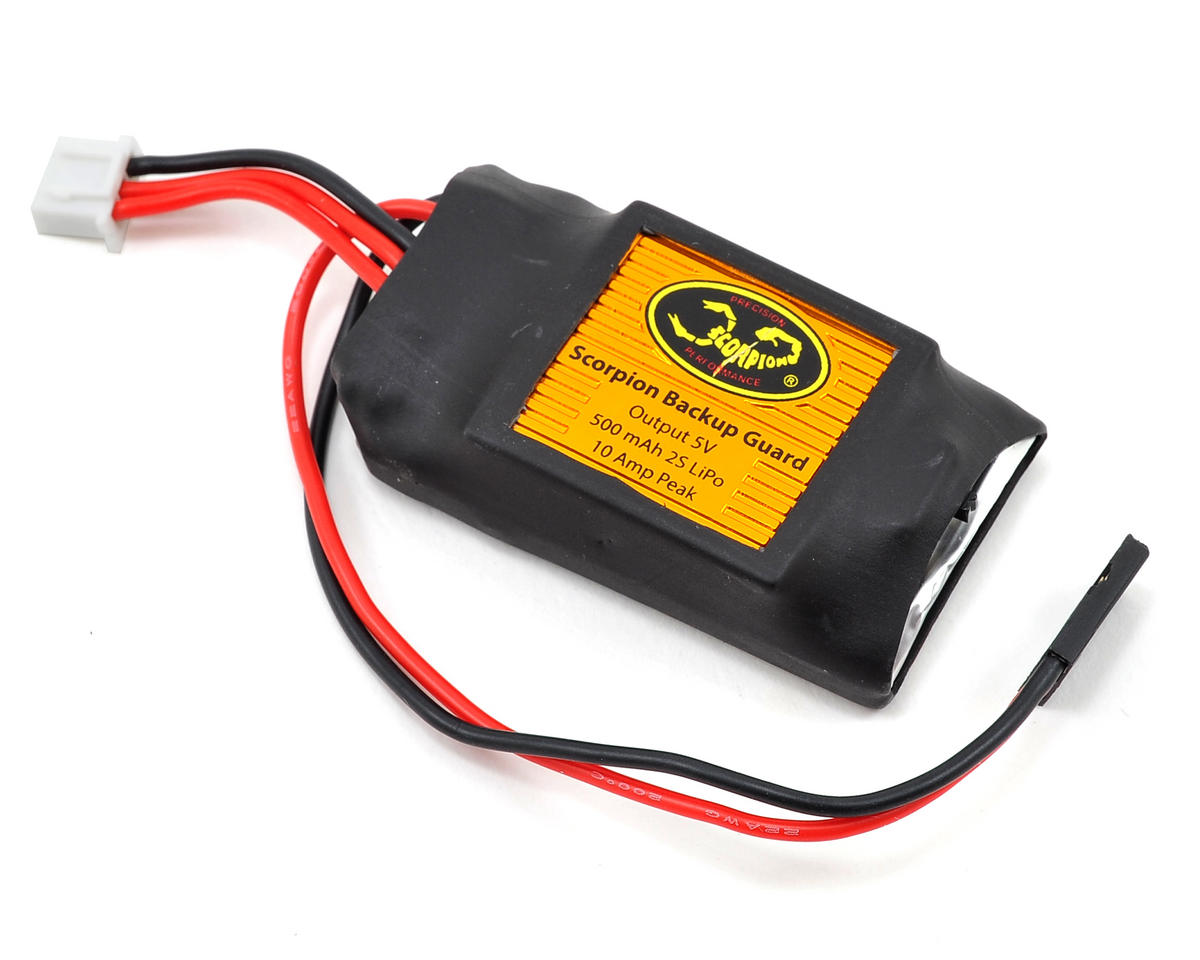
(Get the charge adapter, too.)Comment
-
Kitbuilder,
Wasn't trying to be critical (and I really did know what you meant). However, a lot of people in this forum are here because they are MRC customers. For some, their whole RC experience may be with the type of PNP/BNF foam airplanes that MRC sells. Virtually all of these planes are sold with ESCs that also contain BECs so it's easy to assume that all ESCs will provide power to your RX. Some might eventually decide on an ARF where you need to buy your own components so I thought it was worth a little more discussion on "what is an ESC"?
In terms of your question, I think xviper2 has provided a very good response.
Bill
Comment
-
There are two basic types - linear, and switching. A linear regulator can be considered a variable resistor, and the actual resistance is determined by the load current and the input voltage, but, like a resistor, the excess is released as heat, so the higher the input voltage, the lower the load current can be, before it melts. A switching regulator 'pumps' charge to the output, enough to meet the load, but, because it is not like a resistor, it releases a lot less heat, so can provide the rated load at input voltages that are up to the stated maximum.
When a linear regulator fails, assuming it doesn't just shut down from a temperature limit protection, it can melt into a puddle, and allow the full battery voltage to pass. When a switching regulator fails, the output just shuts off. With either, if the temperature of the regulator is getting too hot to touch, it is probably going to fail; if they remain relatively cool in use, failures are rare (but not unheard of).Also when they fail, they just fail right :( ? Is there anyway to determine if it's at end of useful life before my components get fried?
Comment
-
Thanks for all the info...
I'll have to see which type of regulator I have,
I run 3 cell 1300 mah in case a cell goes I would still have the volts needed?
but from above may go to 2 cell since I'm thinking the relatively benign use of the lipo in how I'm using (constant draw) would not cause cell issues??Comment
-
For BECs, generally it isn't the Voltage but the AMPS that is the concern. Most BECs that I know of regulate the voltage to +/-5volts (usually the range is around 4 to 9 volts). ESCs with built-in BECs are generally rated at about 1-3amps, where common external BECS can be 10amps or more.
Amps dictate how much load the BEC can support... if you've got 2 analog servos & a receiver then a 3amp internal BEC will be fine. Throw in retracts, digital servos for rudder/elevator/flaps/ailerons and analog servos for gear doors & fluff (like head turning FPV servos, cowl flaps and the like) and your amp draw can exceed what that 3-5amp BEC can support. Also keep in mind, static load measured on the ground will not equal dynamic load experienced when the aircraft is in the air, due to the force of the air in opposition to what the servos are trying to do (like moving the control surfaces)
I'd say 8 times out of 10 this is the common "failure" people experience, too many things pulling from a BEC that can't handle it, and it causes what's called a "brownout" ; it under-powers the servos where they lose their strength or it brownouts the receiver which causes it to lose connection to the TX
Heat also occurs the closer to that amp threshold you get.
a general safe rule of thumb for power supplies in ANY electronics (ESCs & BECs included) is to give a buffer zone double the peak load... so for ESCs you look at your motor peak AMPS and double it for the peak ESC value.... BECs you look at your peak amp draw from all your electronics and double it for your BEC value (TBH, most of my planes have yet to exceed the needs of a 10amp) This is a safe practice not only to prevent brownouts but also thermal cutoff ("I squared R" is the calculation, or current squared times the resistance = watts, and watts = heat)Comment
-
For BECs with switching regulators, which are becoming the standard now, this is mostly true, but for linear BECs, Voltage dictates how many the Amps the BEC can provide, because the excess Voltage (any above about 6V) is dissipated as heat (V * I). Thankfully, fewer ESCs come with linear BECs now than just a couple years ago, and separate switching BECs are commonly available.Comment


Comment