
You must Sign-in or Register to post messages in the Hobby Squawk community
Registration is FREE and only takes a few moments

Register now

Announcement

Collapse
No announcement yet.

Could installing a higher C rating battery damage the ESC?

Collapse
X
Collapse
First Prev Next Last
 
  • Filter
  • Time
  • Show
Clear All
new posts

  • #21
    Originally posted by WintrSol View Post
    My IR meter was built by Wayne Giles, and uses a proven algorithm to estimate a true C rating for a battery; it is rare for a battery of ANY printed rating to exceed 35C. The '65C' Turnigy Graphene 1300mAh and 2200mAh batteries rate between 28C and 31C, and most of my 30-40C rated batteries show up in the 23C-28C range. This was at a stable temperature of 76F, BTW. Of course, if you actually used 65C from a battery, continously, it would last all of 44 seconds (assuming 80% usage), and swell up.
    This is VERY good information to post and is something I've suspected for a long time from information I've come across on the 'net. If that's all a Graphene puts out, I can only imagine what a low C Turnigy Blue battery that is stamped "20-30C" is putting out, once again re-affirming (to me anyway) that I should aim for the highest C rated battery I can afford. When it comes to LiPos, there is NO truth in advertising.
    If you ever get a chance to "test" one of the 70C Revos, I'd be really interested to see what those read. I've always thought 70C is quite a claim.
    PS: So far, I have not had a Graphene puff or come down beyond "warmish" and I use them pretty hard, especially in my EDFs. Now that winter is here, I haven't been able to use a Graphene after a flight as a hand warmer like I do with my other batteries. Ones used in prop planes come down with no heat at all and are useless for hand warmers. ;)

    Comment


    • #22
      Just for comparison, I have two Turnigy blue 4Ah 30-40C batteries, that test for a range of 19-21C continuous, and the 4Ah Admiral 40C batteries that the tester says are good for 17-18C continuous, so about 2.5 minutes at that rate. It should be noted that the Turnigy batteries are larger and heavier, which would account for the somewhat lower IR.

      The Graphenes have the lowest IR of any I've flown, and because of that, do run cooler, and have a bit more punch for a go-around; they are significantly larger and heaver than others I have of similar Ah ratings. I've flown them in EDF models which usually heat them up, but there is less heat than the others. My 2.2Ah one was flown in a model that pulled only about 25-27A WOT, so just over 10C; because of the lower internal heating, it came down warm, not hot, which should make it last longer. The Graphene series is a good battery, if you can tolerate the increased weight and size. I have none, but hear that the Revos are also large for the Ah rating, and give similar results.

      Comment


      • #23
        Originally posted by WintrSol View Post
        The Graphene series is a good battery, if you can tolerate the increased weight and size.
        I usually compare weights and dimensions when ordering Graphenes. I end up with a battery that is a couple to a few hundred less mah. These perform better for about the same flight time as the ones they replace.

        Comment


        • #24
          To each their own! All of my videos prove that my planes are not in anyway hampered by my way of selecting batteries. Just an example... my Mig-21 uses a 6s 30c 6200mah pack. Doing the math shows you that the continuous discharge rate is 195amps. My system pulls 120amps max. The battery is very happy and the plane flies amazing!! The pack weighs less than most high C 5000s and the voltage under load is actually better than the higher C smaller packs. If you want to go higher C then go for it! Its not bad but not needed either. And yes with higher C packs you do draw more amps....

          Sorry fro the wind noise and mostly just sky but the close fast passes are nice as is the landing.


          Check me out on youtube at https://www.youtube.com/user/gooniac33
          I am an RC addict and innovator that loves to share my knowledge with those that need help. Ask me anything via PM if you need help! Check out my Website here https://www.gooniac33.me/

          Comment


          • #25
            Sounds about right - at 20C max, that battery is going to do well, as that is likely close to its actual continuous-draw capability. As noted above, it is unusual to find packs that are truly capable of a higher draw, without a severe weight and size penalty; a 5Ah battery rated at 40C or higher is very likely closer to 25C in reality, so wouldn't make up for the penalties. Always be suspicious of ratings much higher than 30C, and never assume they can deliver.

            Comment


            • #26
              Originally posted by WintrSol View Post
              Sounds about right - at 20C max, that battery is going to do well, as that is likely close to its actual continuous-draw capability. As noted above, it is unusual to find packs that are truly capable of a higher draw, without a severe weight and size penalty; a 5Ah battery rated at 40C or higher is very likely closer to 25C in reality, so wouldn't make up for the penalties. Always be suspicious of ratings much higher than 30C, and never assume they can deliver.
              Exactly... the Graphenes have been really good as have Gens Ace...
              Check me out on youtube at https://www.youtube.com/user/gooniac33
              I am an RC addict and innovator that loves to share my knowledge with those that need help. Ask me anything via PM if you need help! Check out my Website here https://www.gooniac33.me/

              Comment


              • #27
                OK, here's what we know so far from those "in the know"......

                1. Graphenes are excellent batteries. (And to a slightly lesser extent, Turnigy Blue and Admirals)
                2. 65C rated Graphenes barely put out 30C (28 - 31).
                3. Many of us have actual real world experience to indicate that the higher C rated batteries (witness: Graphenes) perform better in our planes when compared to low C rated batteries. In most cases, the end users are "lay people" and what we experience with our planes is all we know.
                4. It has been said that 30C batteries are plenty good for what most of us fly and anything in excess of this is "needless".
                5. It is rare that any battery will actually put out much more than 35C no matter what the label says.

                One can then conclude (or at least surmise) from one or more of the above points that "lesser known" and/or lower quality batteries will put out even less than what's rated on their labels. So, using such "lower" end batteries, we are likely getting 1/2 or less, than the printed rating, so if we use 20 -30C rated batteries, we might only be getting an actual 10 - 15C. Most of the common planes we fly these days are designed to safely operate on ~30C. For example, if we buy a 30C rated battery, we are NOT getting 30C. In order to come anywhere near that, we must buy a high C rated battery and hence, we are simply giving the plane what it was designed to have. Following this line of deduction, we can say that putting in a high C rated battery into a plane may not necessarily damage the ESC because we are simply giving it what it was designed to run on in the first place and by using lower C rated batteries, we may be depriving the power system of the plane of what it could really use. All of this merely re-affirms my original notion about buying the highest C rated battery I can justifiably afford. If there was truth in advertising, this practice would not be necessary.

                Comment


                • #28
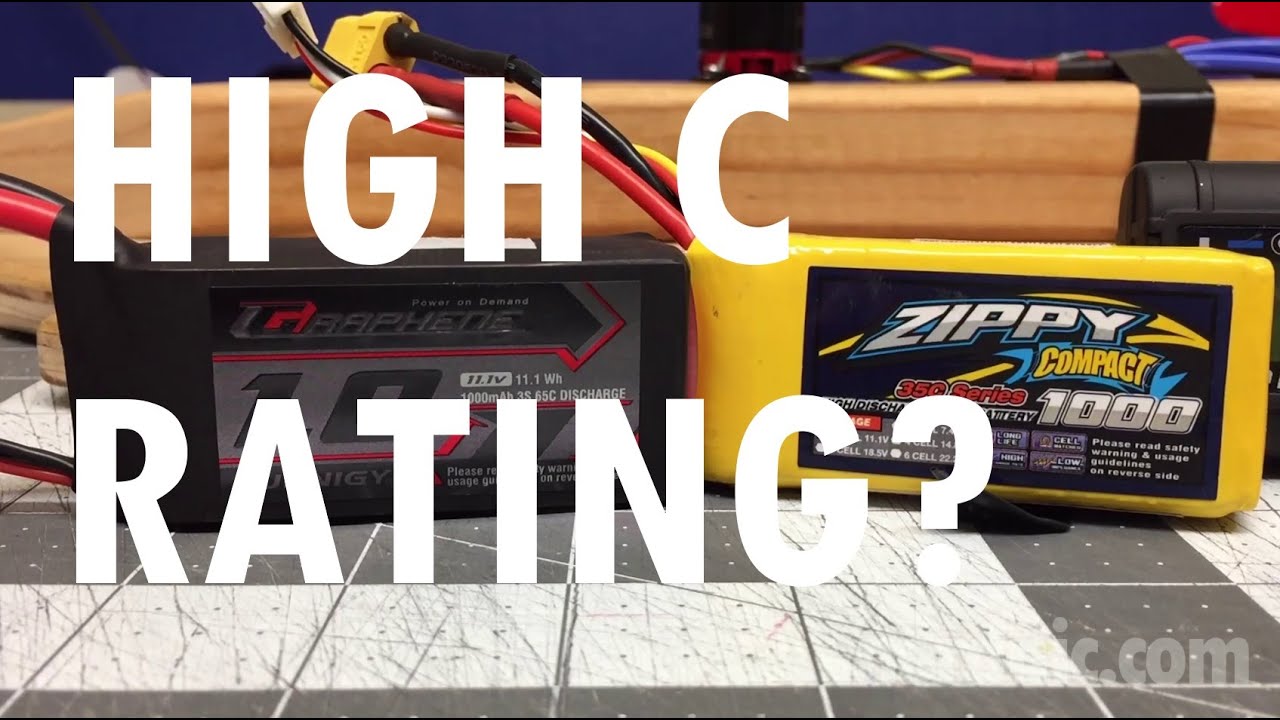
                  Here's an interesting recent video that relates to what we've been posting about.
                   

                  Comment


                  • #29
                    Originally posted by xviper2 View Post
                    Here's an interesting recent video that relates to what we've been posting about.
                    I know Nic personally and that field he flies at in the video is where I fly all the time. We have discussed this very subject and he is only doing one part of the argument. If the Graphene weighs 29g more than the other pack in question then you add in more capacity to equal the weight of the heavier pack but still keeping the lower C. Things changes when you do that. You get more discharge rate when you increase capacity without increasing the C rating.
                    Check me out on youtube at https://www.youtube.com/user/gooniac33
                    I am an RC addict and innovator that loves to share my knowledge with those that need help. Ask me anything via PM if you need help! Check out my Website here https://www.gooniac33.me/

                    Comment


                    • #30
                      This is the video that fits with what I am saying.

                      Check me out on youtube at https://www.youtube.com/user/gooniac33
                      I am an RC addict and innovator that loves to share my knowledge with those that need help. Ask me anything via PM if you need help! Check out my Website here https://www.gooniac33.me/

                      Comment


                      • #31
                        That is, in theory, correct, since discharge rate (Amperes) is supposed to be equal to the Ah rating times the C rating. If C ratings were trustworthy, that is. Because it is now more an advertising gimmick than a useful measurement, it's up to users to find out what a battery can actually provide. As a general guide, though, within the same brand a higher capacity will usually sag less or provide a higher discharge current, if the C rating is the same.

                        Comment


                        • #32
                          Originally posted by gooniac33 View Post
                          This is the video that fits with what I am saying.

                          This video and the one before it, only re-affirms to me that I will continue to buy the highest C rated battery I can justifiably afford. I will even go so far to say that after this second video, I will concentrate my future purchases on 65C Graphenes (and Admirals and Turnigy Blue Heavy Duty when the other is not available). The only variable that has yet to be tested is longevity and these things have not been out long enough for people to see just how many duty cycles they will be good for.

                          Comment


                          • #33
                            Over on the other forum, there is a Graphene thread, and one of the contributors has been doing life testing, cycling batteries at relative high discharge rates. I haven't read the results lately, but his results indicated a good lifetime for them, if not abused.

                            Comment


                            • #34
                              Originally posted by WintrSol View Post
                              Over on the other forum, there is a Graphene thread, and one of the contributors has been doing life testing, cycling batteries at relative high discharge rates. I haven't read the results lately, but his results indicated a good lifetime for them, if not abused.
                              That's very encouraging to know. In the circle of friends I fly with, we consider getting 200 cycles out of a battery is giving us our money's worth. Anytime we can approach 300 cycles, it almost feels like we stole something. :D
                              Our old Admirals are starting to get "tired" now after about 200 - 250 cycles. Nobody's really complaining. We've also noticed of late that Graphenes have taken a jump in pricing. I think it's partly due to the great reviews that have been coming in. They don't cost anymore to produce now as opposed to a few months ago, but I think HobbyKing just feels like they can charge more and people will continue to buy them. If they'd only get rid of those fancy schmancy faux felt bags and individualized boxes, they might be able to knock a few bucks off each one.

                              Comment


                              • #35
                                Wintr.........have been watching that thread too and it does look like the graphene's are the next step in the small package/high voltage technology evolution.
                                Warbird Charlie
                                HSD Skyraider FlightLine OV-10 FMS 1400: P-40B, P-51, F4U, F6F, T-28, P-40E, Pitts, 1700 F4U & F7F, FOX glider Freewing A-6, T-33, P-51 Dynam ME-262, Waco TF Giant P-47; ESM F7F-3 LX PBJ-1 EFL CZ T-28, C-150, 1500 P-51 & FW-190

                                Comment


                                • #36
                                  Originally posted by xviper2 View Post
                                  This video and the one before it, only re-affirms to me that I will continue to buy the highest C rated battery I can justifiably afford. I will even go so far to say that after this second video, I will concentrate my future purchases on 65C Graphenes (and Admirals and Turnigy Blue Heavy Duty when the other is not available). The only variable that has yet to be tested is longevity and these things have not been out long enough for people to see just how many duty cycles they will be good for.
                                  Logic should also tell you that a 1000mah pack with that high of a C will exhaust itself sooner too. So you can look at it from one angle or see the big picture. I look at it as a whole and will stick to capacity instead of C since one is easier to gauge than the other.

                                  Graphene packs are very promising and the Gens Ace packs that came before them were as well. But if you can get good performance and not spend the money why would you?
                                  Check me out on youtube at https://www.youtube.com/user/gooniac33
                                  I am an RC addict and innovator that loves to share my knowledge with those that need help. Ask me anything via PM if you need help! Check out my Website here https://www.gooniac33.me/

                                  Comment


                                  • #37
                                    Oh and that video also proves that the Higher C pack of the same capacity will draw more amps as I said before.
                                    Check me out on youtube at https://www.youtube.com/user/gooniac33
                                    I am an RC addict and innovator that loves to share my knowledge with those that need help. Ask me anything via PM if you need help! Check out my Website here https://www.gooniac33.me/

                                    Comment


                                    • #38
                                      This is a "hobby" and a leisure past time for me and most others I fly with. Spending more money to get a battery that will allow our models to perform to their peak is reason enough for "why". We've all witnessed better performance out of high C packs with even longer flight times while using a slightly smaller mah pack. We all understand that we must buy high C rated packs just to get a lower C pack. That's OK, too. Math and calculations will never sway our minds when it comes to getting real world outcomes. Like has been said so many times already................. Sure, we can get by just fine with a 30C pack but we can't buy a 30C pack that will put out 30C. When the industry can sell us a battery that will actually put out what it says on the label, THEN we will allow the math and calculations to speak for us.

                                      Comment


                                      • #39
                                        Originally posted by gooniac33 View Post
                                        Oh and that video also proves that the Higher C pack of the same capacity will draw more amps as I said before.
                                        And the reason that happens is because there is not as much of a voltage sag(drop) with the higher C. You can not get the desired amperage with reduced voltage which is controlled by the IR and other factors of the battery chemistry that play into the math/science of Ohm's Law. The bottom line to all this great discourse over these 4 pages is the answer to the OP's questions and that is still a NO. As Wintrsol said in an earlier post(I'll paraphrase), you can't force amperage down the motors gullet.
                                        Being the science guy, I actually learned two things throughout these writings. The biggest surprise was the amount of voltage drop that a lower C rated battery had under load and the not so big surprise is the untruthful marketing by the manufactures of the battery C rating. Until that marketing misinformation changes and based upon the two new revelations I gleened from this most excellent thread is that 25-35 C will get the job done for the majority of my prop warbirds but a 40C is a slim low end margin for getting what I want from my two EDF's.
                                        Best regards,
                                        Warbird Charlie
                                        HSD Skyraider FlightLine OV-10 FMS 1400: P-40B, P-51, F4U, F6F, T-28, P-40E, Pitts, 1700 F4U & F7F, FOX glider Freewing A-6, T-33, P-51 Dynam ME-262, Waco TF Giant P-47; ESM F7F-3 LX PBJ-1 EFL CZ T-28, C-150, 1500 P-51 & FW-190

                                        Comment


                                        • #40
                                          If your flight lasts 5 minutes, you average discharge is 10C, assuming 80% discharge; using a battery that can honestly provide more than that is not a waste though, as you will get a better burst of power when full throttle is needed, both at takeoff, and at landing. As to EDF use, most of these models that I've seen or flown have less air flowing around the battery than other types, so the higher C rating (lower IR) means the battery doesn't get as hot, especially since many EDF models fly about 4 minutes or less (>=15C). One of the reasons the Graphene batteries stay cooler is that there is a heat-conductive plate between layers, so what little air flow you have gets more heat out of the pack; great for EDF models.

                                          Comment

                                          Working...
                                          X