

Roban - World Class Scale Helicopters

You must Sign-in or Register to post messages in the Hobby Squawk community
Registration is FREE and only takes a few moments

Register now

Announcement

Collapse
No announcement yet.

New Freewing Afterburner lights

Collapse
X
Collapse
First Prev Next Last
 
  • Filter
  • Time
  • Show
Clear All
new posts

  • New Freewing Afterburner lights

    Click image for larger version

Name:	IMG_1225.jpg
Views:	1480
Size:	33.5 KB
ID:	362598Click image for larger version

Name:	IMG_1224.jpg
Views:	1484
Size:	65.7 KB
ID:	362599

    Has anybody seen these or tried these out yet?

  • #2
    FNRC featured these a couple days ago:
    Comment


    • #3
      I really think these units give a great scale look.
      I would love to have them in my jets. BUT I havent found anywhere that identifies any negatives in either the reduction of final thrust or the amount the install changes the CG. Perhaps it dosent have any negatives. Then there is the afterburner ring and what effect it has on the performance similarly.
      Not looking to be negative in anyway as I think they are really cool looking. Just wondering if there is any downside.
      Cheers
      Bob

      Comment


      • #4
        I made my own version of those, with an Arduino and a little bit of code. In my world, this afterburner simulation needs some flickering. Just like with weathering, less is better.
        But anyway, I use a similar light bulb (LED), but I failed to properly secure the 3D-printed bulb adapter to the EDF motor case, so after a couple of flights, on takeoff of the next, my model literally spit out the whole thing. Which was funny enough to crack up the whole club.
        This just shows that it does have its effect on the airflow. If it didn't it wouldn't have been blown out of the tailpipe. But I never did any measurements of thrust losses. I would say, from an intuitive standpoint only, if thrust is already marginal, don't add these things.

        Comment


        • #5
          One thing they strongly enhance is visibility. It can really help orientation under certain circumstances.

          Comment


          • #6
            Great point Gilatrout. I hadnt even thought about it from that perspective.
            B

            Comment


            • #7
              I make my own, including the controller, and take great care to fair in the adapter to minimize any impact on thrust, unlike most of the commercial offerings. The operating parameters are programmable too - you can adjust the turn-on point, the amount of flickering, the extent to which brightess varies with throttle setting, etc. to suit your own preference.

              https://www.rcgroups.com/forums/show...DF-afterburner

              I make the Arduino program available on request to anyone. You can easily make your own system for a twin for under $30 (less for a single). The one controller will independently control two exhausts.


              Comment


              • #8
                Originally posted by HangarQueen View Post
                I made my own version of those, with an Arduino and a little bit of code. In my world, this afterburner simulation needs some flickering. Just like with weathering, less is better.
                But anyway, I use a similar light bulb (LED), but I failed to properly secure the 3D-printed bulb adapter to the EDF motor case, so after a couple of flights, on takeoff of the next, my model literally spit out the whole thing. Which was funny enough to crack up the whole club.
                This just shows that it does have its effect on the airflow. If it didn't it wouldn't have been blown out of the tailpipe. But I never did any measurements of thrust losses. I would say, from an intuitive standpoint only, if thrust is already marginal, don't add these things.
                My Do-it-Yourself AB simulator program can very easily be adjusted to control the turn on point, the amount of flickering (if any), the way brightness varies with throttle setting, etc. by just changing some constants at the beginning of the code.

                Comment


                • #9
                  Originally posted by kallend View Post

                  My Do-it-Yourself AB simulator program can very easily be adjusted to control the turn on point, the amount of flickering (if any), the way brightness varies with throttle setting, etc. by just changing some constants at the beginning of the code.
                  Yep, that's the way to do it.
                  I remember a great quote about the use of constants in programming, from years ago. They used an example of code to calculate the surface of a circle, first by hard-coding the value of pi, then used the argument for setting pi as a constant at the top of the program, so it can easily be modified, and I quote, "should the value of pi change".
                  I intended to use a separate channel to set the turn on point, making it even more versatile to use in any model.
                  Unfortunately, after being spit out by my FMS Hawk, I kind of lost interest and concentrated on flying. But I might resuscitate this little project for my L-39, which has plenty of thrust. Would be a great test bed for this kind of thing.

                  Comment


                  • #10
                    Originally posted by HangarQueen View Post

                    Yep, that's the way to do it.
                    I remember a great quote about the use of constants in programming, from years ago. They used an example of code to calculate the surface of a circle, first by hard-coding the value of pi, then used the argument for setting pi as a constant at the top of the program, so it can easily be modified, and I quote, "should the value of pi change".
                    Pi will have a different value in the vicinity of a neutron star or black hole, due to the curvature of space-time.

                    Comment


                    • #11
                      You can never have too much pie

                      Comment


                      • #12
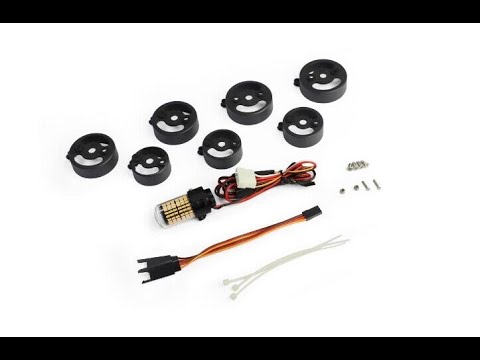
                        We have loads of these Freewing tail Flame kits on the way. I don't have an exact ETA yet. There are two versions. One version fits the Freewing 80mm and 90mm motors and the second version fits non-Freewing motors. The picture posted above is for non-Freewing motors and is a bit more expensive because of the included adapters required. I've attached the initial version of the manual. I think you guys will be shocked at the price (it's very reasonable).

                        The tail flame LED includes a control board. The LED and control board are powered via your LiPo balance connector. The second connector on the control board connects via a Y cable to the receiver throttle channel.

                        Click image for larger version  Name:	Tail Flame.jpg Views:	0 Size:	59.3 KB ID:	362854

                        Comment


                        • #13
                          I prefer to connect afterburners to a separate 2 cell battery usually a jst connection. Not a big deal to change it. Just my preference

                          glad to see this as an easy option and add on

                          Comment


                          • #14
                            Originally posted by Gilatrout View Post
                            I prefer to connect afterburners to a separate 2 cell battery usually a jst connection. Not a big deal to change it. Just my preference

                            glad to see this as an easy option and add on
                            Depends on the LED lamp used whether 2 cells will be enough It *looks* like a 12-14 volt lamp in the photo.

                            They are already available on ebay

                            Comment


                            • #15
                              They are already available. That price will undercut most of the other brands:

                              Comment


                              • #16
                                Will they be sold as single motor or dual or both?

                                Originally posted by Tom View Post
                                We have loads of these Freewing tail Flame kits on the way. I don't have an exact ETA yet. There are two versions. One version fits the Freewing 80mm and 90mm motors and the second version fits non-Freewing motors. The picture posted above is for non-Freewing motors and is a bit more expensive because of the included adapters required. I've attached the initial version of the manual. I think you guys will be shocked at the price (it's very reasonable).

                                The tail flame LED includes a control board. The LED and control board are powered via your LiPo balance connector. The second connector on the control board connects via a Y cable to the receiver throttle channel.

                                Click image for larger version Name:	Tail Flame.jpg Views:	0 Size:	59.3 KB ID:	362854

                                Comment


                                • #17
                                  If you look where they are already available there is only a single version.

                                  Comment


                                  • #18
                                    Originally posted by Skosh25 View Post
                                    Will they be sold as single motor or dual or both?
                                    These are for a single motor/single exhaust plane. A dual motor setup is possible using two of these. You would have to get a little creative with batteries to power the two.

                                    I am talking to Freewing about a setup for planes with dual motors/dual exhaust outlets. I'm also working with them on a second setup for planes having a single motor with bifracated exhaust such as the 90mm F-18, 90mm F-15, 90mm F-4, etc.

                                    Comment


                                    • #19
                                      Originally posted by Skosh25 View Post
                                      Will they be sold as single motor or dual or both?


                                      If you're handy with a soldering iron, my "Do-it Yourself" afterburner controller already works with dual motor systems, and with single motor bifurcated exhaust systems. You can make a dual motor system for around $15 that has each tailpipe flicker independently.

                                      https://www.rcgroups.com/forums/show...DF-afterburner

                                      I have also made adapter designs for a variety of motors:

                                      These are mounts to attach LED lamps to various EDF fan motors. The file names describe which ones. The 90mm_39 dual mount is customized for the Freewing Eurofighter with the 39mm inrunner motor, the 80mm dual is for the E Eflite F-4 Phantom and the 70mm dual is for the FMS F/A-18, although they should fit other twin tailpipe models with the same motors. The adapter "Short_Dual_FMS..." fits the FMS Rafale which has very limited space behind the motor..Most of the adapters are clamped to inrunners using a cable tie. If it says "screwon" then it is specifically for the Freewing 29mm or 36mm inrunner motors, and is less bulky (so recommended for lower drag).)If a spec looks like 90_40mm it means a 90mm fan with a 40mm inrunner motor, etc..With the exception of the special B-1B adapters (see below) if a file contains "screwon", V2", "V3" or "V4" in its filename it is specifically for the lamp listed here: https://www.amazon.com/gp/product/B07R3Z1K3B/ref=ppx_yo_dt_b_asin_title_o01_s00?ie=UTF8&psc=1 These are only $2 each if a 10-pack is purchased, and they are very bright.Otherwise they are for the lamps listed in the following article:https://www.rcgroups.com/forums/showthread.php?3313547-Making-an-inexpensive-EDF-centerburner for details.Make sure lamps and adapters are securely attached and that all wiring is secured so it can't get sucked into the fan. I have added a small converter so that the different lamps in the link below can be used with the earlier adapters. You will need to remove the yellow plastic part and glue the bulb to the converter, which then fits the EDF adapter.https://www.amazon.com/gp/product/B07R3Z1K3B/ref=ppx_yo_dt_b_asin_title_o01_s00?ie=UTF8&psc=1The adapter "Dual Flickr 70_30mm V2 FMS PRO inrunner.stl" is for a single 70mm fan with 30mm motor and with twin exhausts (FMS F/A-18) and has a divider between the lamps so they can flicker independently without bleeding too much into the other tailpipe.The ArrowsRC Mig29 and F-15 adapters do NOT fit onto the EDF motor. It goes in the tailpipe 1mm behind the motor - see the blog description. There is a spacer that can be used to precisely locate the adapter 1mm behind the motor - remove after attaching the adapter in the tailpipe.The 64mm F-16 adapter was created by Martin T and is described here:https://www.rcgroups.com/forums/showpost.php?p=45701171&postcount=331 The 70-30 B-1B adapters are for the XFly (Banana Hobbies) B-1B. The motor wires exit slightly to the side, so the hole in the adapter is offset to suit and you will need to make right and left handed versions It also is designed for the narrow LED lamps to minimize obstruction to the airflow in the narrow exhaust ducts. It is also short due to the limited space behind the motor. There are three slightly different versions.


                                      All of which are considerably more streamlined than most of the commercial systems.
                                      Attached Files

                                      Comment


                                      • #20
                                        I really like the design on these for the Freewing motors. Just simply screws onto the motor! Very nicely done!

                                        Comment

                                        Working...
                                        X