


Thanks Evan. Well, I've never heard of wing and tail incidents so I don't know what that would be. I'm not a builder, just a flyer (unless you call gluing foam pieces together to be building.) Your point about trim makes sense if it's a trim issue. I didn't feel like it was a trim issue because that would come in to play with speed, not throttle. And it seemed like the effect was immediate, before the plane's speed increased. I could be wrong. (It wouldn't be the first time!) At any rate when I get the chance to fly it again I'll see if my tinkering with the nozzles has had any effect and if not then I'll move the battery forward.
My Roaring Top 2200 35C's are a little lighter than the comparable Admirals. They're 210 grams vs 226 grams for the Admirals. But my CG is about 65mm with battery and canopy on and that seems to be what I've seen other people use. In James' and Captain Blasz' videos they didn't seem to mention using a different CG and James' setup for the elevators seemed to be aligned with the glue line on the fuse so that's where mine was initially before I cranked the clevis out a turn.
I'll be sure to post an update after I fly it again.
-
Hello. I am currently trying to test my edf. When it's plugged in it goes through a bunch of beeping patterns and never turns on. If I press up or down on the throttle nothing happens. But the edf itself sounds like it's beeping?Leave a comment:
-
Welcome Doug.
When a plane is nose heavy you add up trim to fly level right? That up trim causes the plane to sink when flying slower and to pitch up when flying faster.
Same for a tail heavy plane that you give down trim to, pitches down the faster it goes. In this case people are adding nose weight to correct for CG and remove the trim so it doesn't change pitch with speed.
Another thing to add is wing and stab incidents. Some model makers don't get that right and it can cause a similar issue.
Hope that makes sense.Leave a comment:
-
Well, if the plane noses down with throttle, how can moving the CG forward make it do that any less?
What I've done for the moment is to carefully remove those plastic nozzles and then re-glue them, making sure they don't have any gaps and making sure they don't have any downward slant. The next time I get out to the field I'll try flying and see what happens. If that doesn't help I'll give your idea a shot and see what happens then.
I opened it up and inspected the EDF unit and was a little surprised to see that it's not screwed down at all, just held in place by the foam cover, which is screwed down. Seems kind of chintzy. Every other jet I've had has had the fan unit securely screwed down through the tabs on the fan. It's a cheap model but ...
Leave a comment:
-
Just my 2 cents.. I fly the F18 64mm using an admiral 4s 2500mah pro I’ve upgraded the edf to a Qx motor 3800Kv and use a ZTW esc 65amp, I use the landing gear, I feel it’s more realistic with the gear.. I think it flys great like this! In my opinion really no need to put a 70mm fan in it, and believe me I thought about it!. the air intakes are not designed for it and just adds weight that it doesn’t need!!Leave a comment:
-
Hi Guys,
Just saw this new post and wanted to give you all an update... I have flown mine a couple of more times and moving the CG forward seems to have fixed most of that issue/tendency for me. It also doesn't mush the tail or drag the tail in the corners as much as it did with the CG at 65mm. However It does seem to take a little longer of a roll out to get airborne though. Give it a try, hope that helps. (Not sure where my CG is at now, but I added / taped an ounce of lead to the front of the battery, so you can use that as an estimate.)
Good luck,
mm51Leave a comment:
-
I wish James would comment on this issue because I have EXACTLY the same problem. My first attempt was a hand launch and it nosed down and crashed, messing up the nose, which broke into 3 pieces. That was back in May or June of this year, 2021. I couldn't figure out what was wrong. I fixed the nose finally and today I took off on a paved runway. It needed a long roll-out to get airborne and then humongous up trim. I was pulling back on the stick constantly. I had the elevators set in line with the glue line on the fuselage. That's where several people said they had set theirs.
I landed after a couple of passes and cranked out one full turn on the elevator clevises to give more up trim. Then I flew two full flights with my Roaring Top, 4S, 35C, 2200 mah batteries. I discovered the same thing you saw: with throttle, the plane dove. With no or little throttle the plane flew straight and level. As soon as you give throttle, down it goes. So I put in those 2 full flights of 4'12" and 4'27" and landed with 11% and 10% on the batteries. (I maintain a careful flight log of every flight, noting flight time and battery readings.)
My impression was that the plane needed full throttle to do any aerobatics. Half throttle didn't cut it for doing a simple inside loop. The plane was no speed demon and didn't seem near as fast as James demonstrated in the Motionrc video.
Here's is what I think must be true: The nozzles on the exhaust must be pushing the tail up. And to compensate I have to give a lot of up elevator. So I'm reducing thrust and increasing drag with these 2 things. So why are the nozzles pushing the tail up? I looked at the manual again and it says nothing about it. Just glue the nozzles on. I looked at my nozzles very closely. I can see that there's an air gap along the bottom of the nozzles, yet they're tight at the top. Maybe that creates a slight downward slant of the nozzles? I don't know. And I don't know if a slight downward slant would cause this huge push up on the tail. I don't see any slant visibly so it must be slight. And the manual doesn't say that this is critical. So it's either a design flaw in the airframe or else an imperceptible misalignment of the nozzles has a huge effect on the flight characteristics. If the latter, then I would say that that is also a design flaw because a critical assembly step shouldn't be left up to the customer with no warning.
I'm an electrical engineer, not an aerospace engineer so I can't claim any great insight knowledge into which thing is true. But either way I think this model has a serious problem. I wonder how many other people have noticed this kind of problem. I wonder if a lot of the crashes that people mention are because of this? Just thinking.
Leave a comment:
-
Sorry for my late reply, but I've been on the other side of the world for the last 2 months. Yes there is enough foam to carve out and put a 70mm in it, you can also add flaps, twin rudders and a 6s capable ESC in her, I've done it. I also trimmed the tail nozzles back a little, enlarging the exits too help get that extra flow from the 70mm out of her. Although I have flown her on 2200mah 6s, I've found she flies best with unlimited vertical on 5s 2200mah.Leave a comment:
-
-
I just recently got the high performance version of the F-18 64m I was wondering considering it’s ESC could it handle a 2200 6s battery?Leave a comment:
-
Hi guys, I just picked up one of these and I have a question... when flying this F-18 it seems to nose down when I give it throttle and then balloons up when I get off the throttle completely. Do you know what could be causing this tendency? (I have the CG balanced to middle of suggested range (65mm), as best as I can tell by lifting the plane with my fingers.) Thanks!
Any other possible causes other than CG?
Oh and one more question, is there generally enough extra foam thickness to cut out of a 64mm plane to put in a 70mm fan? Or usually not possible to make it fit?
Thanks!Leave a comment:
-
Today I re-maiden my F-18 tophatter 64mm EDF. The maiden failed because the elevator setting was not good. The manual didn't mention anything about elevator setting. I found the setting from pilots who reported successful flight.
So with corrected setting, I tried the second time. But it failed again, and the model fuselage was crashed into pieces.
The model has Admiral 6 channels receiver plus Eagle gyro. Gyro setting to low gain, about 10 clock direction. Elevator is at 45%, expo 40; aileron at 65% expo 40%.
Here is what happened: this time I tried hand launch. I got help from a RC pilot in the park, who agreed to do the hand launch. Before launch, a power test was done. The helper grabbed one wingtip, I push the throttle to max. The model rotated up as expected. However, the helper commented the plane was lack in power because he expected stronger force.
Anyway, despite the power test, the flight was carried out. After launch, it flied pretty sluggish, it flied up and down. I felt there was no much aileron control. It just kept flying forward, without being able to turn. After a short while, it crashed.
After I got home, I tried to measure the thrust from the fan. I simply directed it to a digital scale, and blow to it. I got a reading of 640 gram. It was far less than what the manual mentioned of 900 gram.
Another issue I noticed, my 6 channel receiver RX600, I didn't really makes it two antenna to be perpendicular to each other. They were kindly together.
Any possible reason why it crashed? Is this stock 12 blade fan EDF good for hand launch? Any guess why lacking of aileron control? Or antenna setting causing unreliable control?
Thanks a lot!Leave a comment:
-
The CG should be more or less in line with the wing cuff on the leading edge if that helps any?Attached FilesLeave a comment:
-
-
I tried it at 70mm from the wing root glove, and for me it was too tail heavy, wanted to sit on its haunches throughout although it was still flyable.
My CG is closer to 60mm now and I slid the battery right up underneath the cockpit, it’s perfect for me.
The manual I’m looking at says 60-70mm from the the wing root glove.Leave a comment:
-
Hi guys, I've also purchased this F18 64mm edf V2, I'm. Battling with the CG as per the manual 90mm to 100mm with a 4 cell 2200mah battery pushed all the way back it is too nose heavy. Could there be a different CG measurement from the leading edge of the wings. I see some comments say that they had better CG between 65mm and 70mm? ThanksLeave a comment:
-
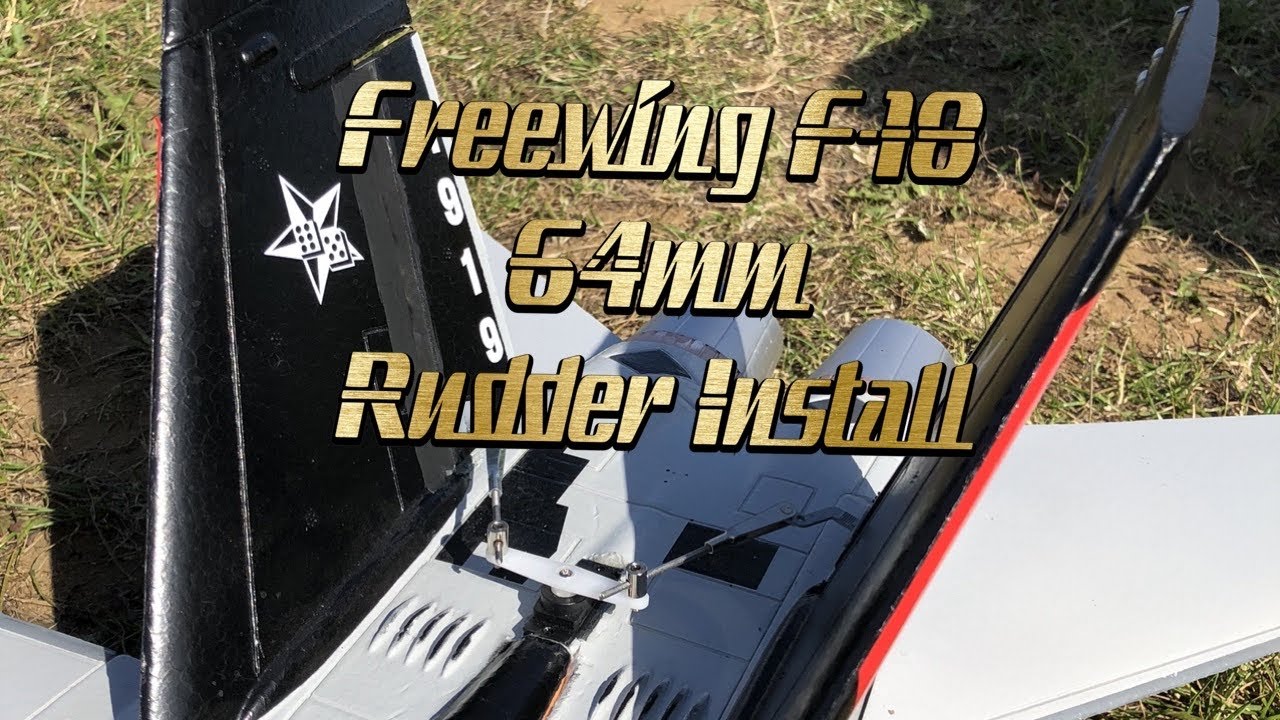
Just test flown my rudder modification on my 4s 64mm F-18 ... what a difference! Rolls are now far more axial and I can swing the nose round in the turn to counter the adverse yaw mine seemed to have but most of all far more control in high Alpha.
I used a Savox SH-0257mg (the only micro I had around) which is an amazing servo but at 12 grams perhaps not the lightest. Pushed the battery up into the nose so no extra weights required (I hand launch her so weight is important).Leave a comment:
-
You need to reverse the throttle channel on Futaba radios. Fellow Futaba pilot here. After reverse, calibrate your ESC throttle range.Leave a comment:
-
Can the elevator servo horns be reversed so this thing can belly land on the grass?Leave a comment:
-




Leave a comment: