



wanted to attach couple pictures i took with my phone but it did not worked out for some reason 🙁
-
-
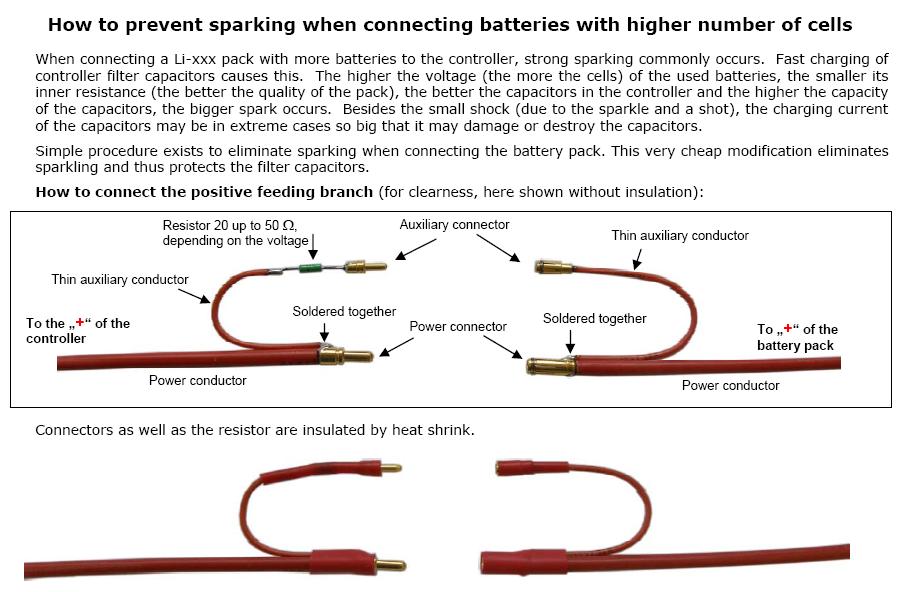
Yes, I make my own anti-spark or use the Jeti units.
Here is a light discussion about them.

http://www.rcheliaddict.co.uk/kontro...onnectors.html
http://www.hobbysquawk.com/forum/ele...014-connecters
I don't use watt meters rather, I like the inductance type DC Amp meter
https://www.zoro.com/extech-clamp-me...50/i/G0632311/
I've been told that Hobby Squawk does not want to become a technical journal (Going into or adding detail can make some folks feel inadequate). So this is about all I can offer. I will say that those resistors in my set up are two 10 Ohm 1 watt resistors set up in parallel (5 ohm 2 watt total). This will charge most ESC fast enough and protect the connectors.
Good Luck, I should say you probably don't need them unless you have added extra Capacitors to your ESC.Comment
-
this is how it looked after crashAttached FilesComment
-
-
You need better solder joints and/or heavier/better wire
I've gone to high quality copper wire and 5% silver solder for my high current applications. Aluminum wire will not handle the same current as copper any you need considerably heavier wire if using aluminum.
I also recommend anything above 4S or 50 amps have a separate RX battery. I use 2S LiFe for the RXs which is OK for any servo rated to take 6 volts nominal.
You don't want a failure of the high current ESC wiring to disable control of the aircraft.FF gliders and rubber power since 1966, CL 1970-1990, RC since 1975.
current planes from 1/2 oz to 22 lbsComment
-
500 mah to 1250 mah LiFe is pretty light... Shift main battery a bit fore or aft and stick the LiFe at the other end.
You do have to monitor the LiFe or be paranoid and put it on charge after each flight.FF gliders and rubber power since 1966, CL 1970-1990, RC since 1975.
current planes from 1/2 oz to 22 lbsComment
-
Wire looks to be the max gage that will fit into the solder bucket of the EC-5. Silver bearing solder (less than 10%) is a good idea if one can supply the added heat (it doesn't melt at too much higher heat than 40/60 solder but it is higher) ("Silver solder" 12% [some text start at 15%] or more really is a brazing process and takes more heat as the silver content is increased). I don't see why aluminum wire is mentioned. The wire in the photo looks to be properly tinned. (Are there reliable aluminum to brass solders?)
At this power we should be using crimped on connectors. Tests have shown that crimped on connectors have a lower resistance between the connector and wire than a soldered joint. (This is why all the electrical power cables in the new B787 (full size aircraft) are crimped) Crimping also affords a much better mechanical joint. The Only crimped on connector for our toys that I'm aware of is the Anderson - Power Pole (Sermos). And these are really too small for this application.
The addition of an RX battery while at first sounds like a good idea. It is another point of operator failure. Modern SBEC (switching BEC ) are more reliable as they eliminate this need for operator input (charging). And with modern 2.4 gHz radio the potential for RF interference from the SBEC is all but eliminated. ESC's such as the Gecko and Talon have more than enough capacity to power the servos that come stock with the SU-35. Should one have upgraded to digital servos the discrete (ADD ON) BEC sold by Motion RC (ZTW and Castle Creation) are fine.
Now the only benefit I see to a separate RX battery is, if one fears the power battery will fail. Like a joint between the cells will open up. Or in this case the connector will fail. But with the RX battery I see more connectors to fail. And I see the operator issue (often me) being a far more likely cause of failure.
I use 500 mAh 2 cell LiFe with a regulator (BEC) for my 'none electric' model Rx needs.
https://vortexhobbies.com/protek-pro...63dcbe24d5d614Comment
-
i dissasembled "killer" connector and inspected it closely. it's got alot of spark damage on it. i think most likely that was the cause of the heat increase in this connector.
also wanted to ask you guys: on ESC there are two resistors on each. they are a little bit mangled after crash. i test controllers and they work fine. what those resistors do and will it affect perfomance of the ESC?Attached FilesComment
-
-
Resistors? I suspect what you are looking at are Capacitors (caps). A photo would help a lot. But any physical damage to the caps (Low ESR electrolytic Cap) means they should be replaced. To learn what those caps do you might want to look up "Ripple Current in ESC's". The short of it is, that the caps protect the delicate switching transistors (mosfet)
To be honest the connector does not look too bad, not great but not really bad. The issue that the sparking cause is it places deposits on the contacts. I bet there are some deposits on the inner diameter of the battery's female connector. These deposits can be bits of the connector and or carbon from the burning spark. More and more deposits after each insertion causes a higher and higher resistant connection between the ESC and battery.Comment
-
KJD: yes, capacitors. just could not find that word in my vocabluary 😊Comment
-
i will post pictute when will come back homeComment
-
Then they need to be replaced! Or the ESC's need to be replaced. Do not fly the model with the damaged cap as they will result in the mosfet becoming damaged in short order.Comment
-
I know this is getting too technical for Hobby Squawk so I apologize, but here goes.
If you can't change out the Caps at the PCB level. You might want to look at replacing them with after market cap boards. Almost all the high end OEMs( YGE, Kontronics, Castle Creations etc.) have these. They are easy to add to the ESC's battery leads.
http://www.castlecreations.com/produ...-cap-pack.html
But you will need to cut off the damaged Caps at their leads. You don't want the damaged caps shorting out later.
Don't know if the repaired ESC with the Cap blocks will fit back into the SU 35. So you might want to repair these ESC and save them for another project.
Now here is where I usually get my low ESR (Equivalent Series Resistance) caps. (note there is not an industry definition of low ESR but look for electrolytic caps that claim to be suitable as switching caps).
http://www.mouser.com
http://www.digikey.comComment
-
Thank a lot for detailed info. i added a picture how bad my caps looks. mine ones are made by Rubycon and i found them online. but to replace them that's another story. they are attached between two circuit bords and to get access i need to separate those boards by unsoldering 16 bridges which connect them.Attached FilesComment
-
-
in boats we have to disapate heat so we use 5.5mm gold connectors and they can go up to as much as 8mm connectors on motor and esc sides and on the battery....u should be good with 5.5 or 6.5 connectors on any foamieComment




Comment