-
Do you guys think the eurofighter gear is just as tough as the 90mm f22 raptor? -
Ah thats a first for me, good to know. Does it need to be reinforced or are we talking about "stress cracks"
Leave a comment:
-
-
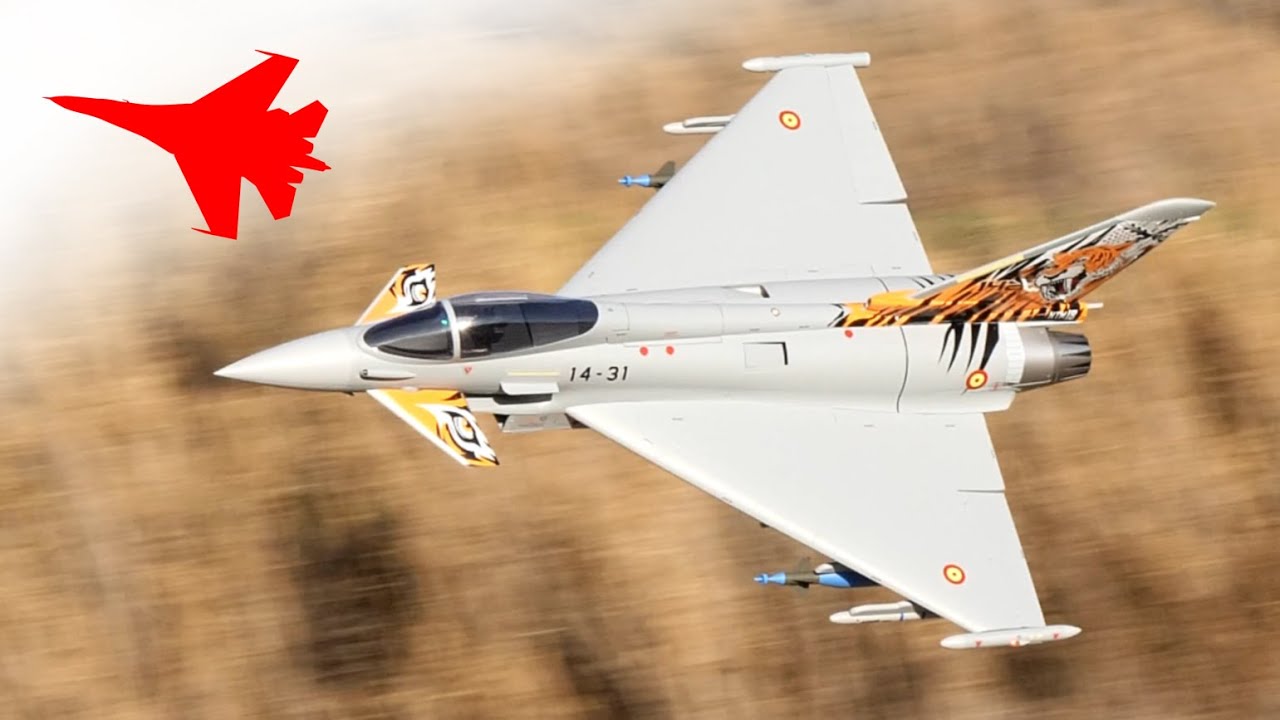
The Eurofighter is a highly maneuverable (acrobatic) aircraft. Scale flying IS acrobatic.
or any of the other airshow videos.Leave a comment:
-
Question:
Does the eurofighter have a tough gear to handle bumpy runway. "My" rubway is made out of some sort of carrotcloth (prevents roots and grass from groing trough) on top of a grass field. So its a bumpy runway no matter what.. so far my mirage 2000 is handeling it because the gears fold back. Is this going to be a problem with the gear?Leave a comment:
-
My previous statement still stands. Even with sub 700g batteries it is quite nose heavy out of the box.
"At a minimum I’d do 25-30. Dremel the plastic exhaust and add that there and then if you need more put it under the vertical stab." Or put 3D printed tail pieces on that you can add lead to...Leave a comment:
-
-
It's also a more accurate shape.Leave a comment:
-
Depends on what your set up will be, anticipated battery weight, etc. At a minimum I’d do 25-30. Dremel the plastic exhaust and add that there and then if you need more put it under the vertical stab. Kallen and others have 3D printed tail parts that can make it easier to add weight.Leave a comment:
-
Both the 6S and 8S fans are really good on this plane and they both use the same reversable ESC. When I had mine on 6S I used a 6200-7000 lipo. When I put in the 8S fan I use a 5000 6+2 that weighs about the same as the 62-7000 6S. Point being the all up weight was about the same. The 8S is maybe 10mph faster. It really is not a very fast plane either way. If I was buying it again I'd probably get it 8S but I have a ton of batteries for it either way.
I didn't like my Zeus that much for some reason. But I think most would be very happy and it's much more a speed/ pattern type plane than the Euro. Also consider the new J-10. Similar to the Euro but a bit more efficient ducting and smaller wing planform so a bit faster than the Euro but also heavier loading. I think of the three I'd go with the J-10. And then there is the best in class F-22.Leave a comment:
-
For my next jet, i'm looking for speed and agility. The Eurofighter seems to have both. Question, how much faster and power does the 8s have over the 6s? Is the 8s worth getting? I know it's a subjective question. I have a biased toward speed but I do like to slow it down in between speed passes. Also considering 8s Zeus.Leave a comment:
-
https://youtu.be/Agb_Dkc_OxQ Eurofighter at RAF Coningsby in case you missed itLeave a comment:
-
Thanks!
I fly the Euro almost exclusively with ordnance. Beside the looks I feel it improves handling in a number of ways (ofc at the expense of T/W and top speed, but those are good enough on 8S that sacrificing some is not a big deal). And they help shift CG back. Also help with knife edge. ;)Leave a comment:
-
-
So... I've finally found some time to write down my Eurofighter settings as they are currently, although I want to change some things, but many have repeatedly asked me to post them as they are now since they like the way it's flying at the moment, so for what it's worth, here they go:
My Eurofighter is the 8S version, with the pilot figure removed, one 4S pack sitting under the airbrake, an extra 2S Li-Po and 8-15A Turnigy UBEC to feed the electronics, ribbon wires and MCB removed and equipped with a Jeti Rex12A stabilized receiver, a MUI200 current sensor and a Freewing V2 LED controller plus an additional green LED for the HUD mockup.
Weight:
Airframe with wing pylons: 3200g (roughly)
8S Li-Po: 806g (2x HRB 4S 4200mAh 60C)
2S Li-Po: 46g (To power electronics)
2x Bombs: 42g (21g each)
2x ASRAAM: 12g (6g each)
2x EFTs: 66g (33g each)
Tail ballast: 20g (I just installed it, haven't used it until now)
TOTAL WEIGHT
4052g (only pylons attached)
4106g (+2x bombs & 2x ASRAAMs)
4172g (+2 EFTs)
CG:
Measured with respect to wing molded factory marks, landing gear up, RETRACTED.
-20mm (only wing rails)
-24mm (w/ ASRAAM and bombs on outer pylons)
-27mm (w/ EFTs in addition to all the previous)
CG note: My elevons currently have 2mm pitch-up trim, so my recommendation is to actually use further rearward CG setup to get rid of the trim. I don't recommend trimming it out with canards. My guess is that 30-35mm should be the sweet spot for most, 40mm and further getting very close to neutral territory so only recommended for people wanting absolute best aerobatic performance, preferably with a proper pitch-gyro installation on canards at least, or canards + elevons.
Another note: Remember that the CG setting is weight sensitive. A same CG position gives a different degree of stability depending on the model's take-off weight, so you should bear in mind that if you are flying heavier than me, then the same CG position (while within the stable margin) will yield a nose heavier aircraft, and a lighter build will yield a tail heavier setup.
Also mind that my CG measuring is not really exact, so allow margin for error of a few millimeters, take this as an orientative value +/- 2 or 3mm.
Linkage settings:
Elevons and rudders: pushrods attached on the outermost hole on both the servo arm and the horn ends.
Canards' pushrod attached on the SECOND outermost hole on the servo arm for a slightly increased control surface deflection.
Mechanical offsets
Left Elevon: +2mm (pitch up) measured on the trailing edge, innermost chord
Right Elevon: +2mm (pitch up) measured on the trailing edge, innermost chord
Canards: -6mm (pitch DOWN) measured on the leading edge against the nose fuselage factory marking for 'neutral'
Rudder: Centered
RATES:
(High / Mid / Low)*
Elevons (roll) 125/100/60
Elevons (pitch) 125/100/70
RUD (yaw) 100/70/50
Canards (pitch) 100/100/80
EXPO:
(High / Mid / Low)*
Elevons (roll) 75/70/70
Elevons (pitch) 75/70/70
RUD (yaw) 70/70/50
Canards (pitch) 60/75/60
*Note: I fly always on high rates, so the first value is the only one that really matters IMO, but if you feel paranoid about twitchiness, you also have my mids and lows.
Physical Throws:
(High / Mid / Low rates, measured in mm, using the same references as used for the offsets)
Left Elevon (Pitch up/down) +47/-39 +37/-30 +26/-20
Right Elevon (Pitch up/down) +47 -39 +37/-30 +26/-20
Left Elevon (Roll left/right) +47/-39 +37/-30 +23/-18
Right Elevon (Roll left/right) -39/+47 -30/+37 -18/+23
Canards (Pitch up/down) +25/-50 +25/-50 +18/-42
Rudder (Yaw left/right) -41/+46 -34/+40 -26/+30
Servo setup:
Adjusted channel endpoints on the transmitter to achieve the full available throw, but limiting deadbands at the end of the servo travel.
The values obtained changes from servo to servo but most typically values are 115 -125 - 150%, depending on the servo.
Gear Door Sequencer:
(For Jeti users)
Landing Gear: 100% (0s) / 100% (3,25s) / -100% (3,5s)
Front Door: -125% (0s) / 125% (2s) / 125% (6s)
Gyro settings:
(For Jeti Rex-Assist receiver users, or as rough orientation for other brands)
Airplane settings:
Gain/Heading Hold Gain**
Ail 22 / 0
Ele 30 / 15
Rud 22 / 5
**I don't use HH, but I have it set up switchable to experiment. In any case, roll HH is always off, gain set to 0, to prevent severe uncontrolled adverse yaw events such as gyro inducing spins while flying high alpha.
Stabilization settings:
M1: Manual (Off)
M2: Normal (Damping)
M3: Heading Hold
Fail/Safe: Intelligent Stabilized (Active in M1)
Acro Mode Settings:
Max roll rate: 320º/s
Max pitch rate: 320º/s
Max yaw rate: 280º/s
Stick Priority: 100% on all axis
Ouput period: 17,5ms (57Hz)
Controller PIDs: (Default values)
LPF: 40Hz
PID-Derivative LPF: 20Hz
Roll MASTER Gain: About 30-50%***
Pitch/Yaw MASTER Gain: About 50-80%***
***I have separate knobs to control roll master gain separate from pitch/yaw master gains, as the roll is the most sensitive axis and most prone to produce oscillations. I move my masters all the time, so I can't provide a fixed value. 20-30% for roll and 75% for pitch/yaw should be good though.
At the moment, my gyro gains for pitch on canards and elevons are the same, because the Jeti receiver doesn't allow to split them, sadly. This is not ideal, I'd rather have a higher gain set up on the canards. I guess I'll eventually install a stand alone gyro for the canards, but for the moment I'm experimenting with a single gyro setup, and picky though I may be about it, guess it's perfectly fine for 99% of users anyway so... that's that!

Leave a comment:

.png)



Leave a comment: