-
I have the same problem. Discovered my nose gear pin is bent and causing the nose gear to bind as it retracts. I believe it doesn’t quite make it far enough to satisfy the limit switch and therefore stops working. If I apply a little pressure on it to help the limit switch get activated and select gear down then it works. I replaced the 3 in 1 connector thinking it was a connection issue but it seems to be mechanical binding. Gonna order new pin or pound mine straight. Should fix it. -
-
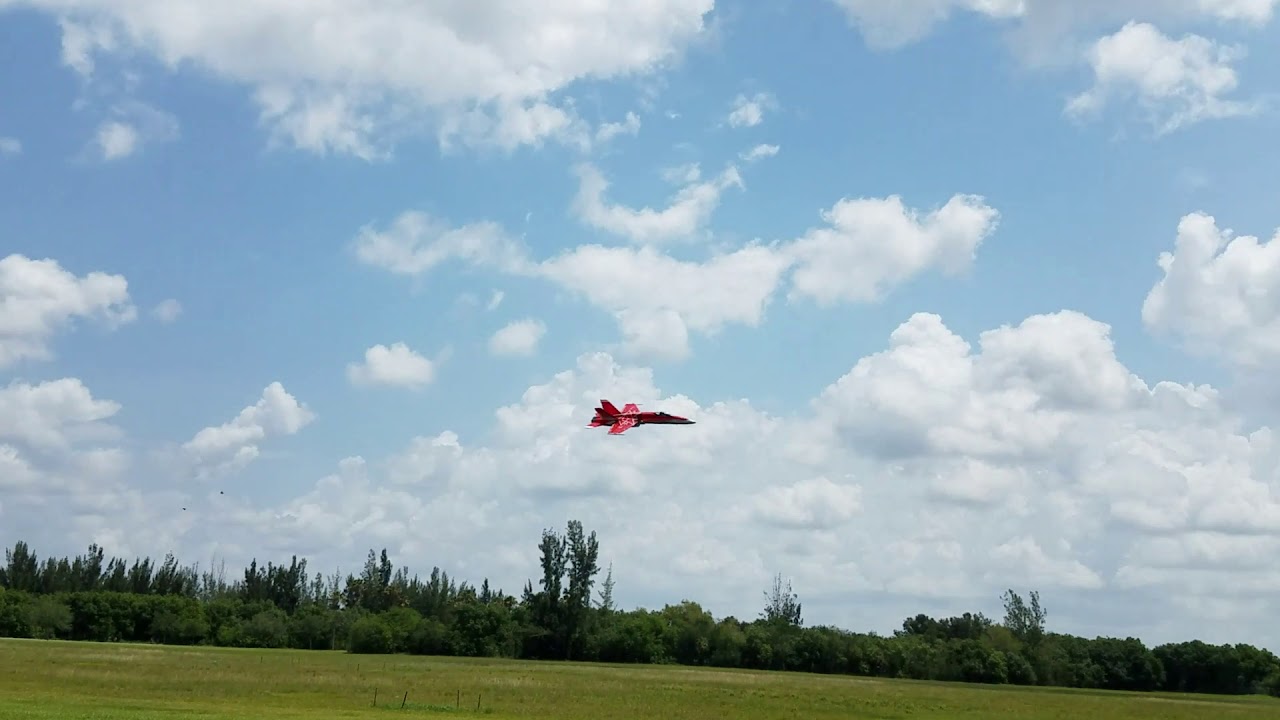
Hows this for High Alpha
That's Franco Di Mauro, one of our members and the owner of House Of Power. He builds/sells high end turbines mostly and is one of the top medal winning jet pilots. He's maidened some of my planes and done things with them that are just not possible, at least by me. I did get my 90 mm F-4 into a hover for at least 5 seconds twice, but not on purpose. The first time one of the elevators came loose and it gyrated wildly and ultimately I somehow got it 4 feet off the ground in a hover, then cut the throttle and landed it like the moon lander with no damage. The second time I had too much up elevator trim on take-off flaps and then compounded it by giving it too much up elevator on take off into a strong head wind and it ended up about 30 feet off the ground in a hover for what seemed like an eternity, then got it to eventually level off and fly right. Both times I ended up with my pants full of :poop:, but the spectators at the field thought I was just showing off (until they smelled my pants).
Leave a comment:
-
Hey Mach9 , check out this crazy guy and high alpha with his 8S 70mm F-16. So that's what you meant by High Alpha, so I guess I'm still at "Low Alpha", but I am working on it.
You can skip the beginning and end and just check out the flying in the middle.
Leave a comment:
-
Ah So, makes sense to me. Maybe the only difference is that I always keep some power on the throttle until all 3 wheels touch down and I've noticed some pilots chop the throttle before touchdown. I guess whatever works. I did finally pull a wheely today on my F-16 (first time ever with that) even though I came in on grass. Kept the throttle up to 20% even after the mains touched down. The only thing I have to be careful of is the 2 fins on the aft underside scraped a bit on the grass, but no damage.Leave a comment:
-
Thanks for the info!! That video to me looks like a normal landing with flare which is what I always try for with trike gear. I guess I was thinking high alpha is what you referred to as a wheelie. I have dropped in too hard (causing bounce) here and there, especially with a tail wind making my air speed less than what I had judged. I have flown a few tail draggers. My "field" makes it easy to flip forward, especially if you hit a mole hill, crawdad or deer hoof hole. I seen a full scale warbird flip forward and bend the prop. They were not happy. With a floaty 3D tail dragger if you get it right you can high alpha and set it down for a vertical landing!Leave a comment:
-
Oh, and one last thing I failed to mention, I cheat on the throttle settings on all my planes/jets for landing. I set the notifications on my timer to tell me when 1st I'm at the correct throttle position on entering the glide slope (timer 1 will say "timer stopped" at say 28% throttle) and then 2nd when I'm at the correct throttle setting to be able to get it into high alpha without gaining altitude (timer 2 then says "timer stopped" at say 21% throttle). Each is different, those where for the F-4, F-16, F-18 and SU-30 all with landing flaps and the SU-30 also with speed brake. If I remember correctly, the Stinger 90 and Avanti the 2 timer settings work at 21% for the glide slope and 14% or less for going into high alpha. Most good pilots don't need to do this, but for me, I'm never quite sure where the throttle is at unless I look (bad idea) or it's at full or off throttle.
Tail dragging prop warbirds are just the opposite. Do not land them via a flare. This not only looks "un-scale like", but can sometimes result in crushing the retracts, especially the Corsair (don't have to tell you how I know). Those MUST be landed on the 2 main gear ONLY at a perfectly level attitude, then let it roll out and drop the tail when you cut the throttle. For those, I set my "notifications" at 40% for the 1600 mm Corsair (I know, it seems high, but with full flaps-even more than book deflections cause I like the way it looks, it lands nicely there for me and no more crushed retracts), the 1700mm P-51 at 35%, and the 1600 mm Spitfire at 25%.
But this is just my somewhat unorthodox landing methods, just do what works best for you. 3 point landings with jets are OK, but this does tend to put undo pressure on the nose gear. Work on a high alpha landing and not only does it look scale, but relieves the stress on the nose gear. With the F-4, that type of landing (3 pointer) can also break the nose gear pin (again, been there, done that).Leave a comment:
-
Mach9 Regarding the CG, it can be done at the recommended book CG, but is definitely easier to do it if you have the CG back a little (although the F-16 will do it even nose heavy). I tend to fly most of my planes/jets maybe about 5mm further back that book recommendations, but not because of landing, it just flies better for me there.Leave a comment:
-
Mach9 you should be able to do a high alpha landing on virtually any of the planes/jets. You need to come in on a normal glide slope but change it to a shallow angle about 6 feet off the deck, and then get it at a speed that is slightly above stall speed when you are 1-2 feet up, yet not fast enough that the jet gains altitude with up elevator input. Try this about 1-2 feet off the deck and if you are at just the right speed, the nose will rise without the jet gaining altitude. This in itself will slow the jet down even more and it will loose altitude with the nose up, eventually touching down on the 2 main gear. That is the preferred way to land virtually all of these jets. Watch any of the videos people post and you will see most of the good landings are done that way. It took me a few tries with each jet to determine that speed, but I can do that with the Avanti, Stinger 90, F-4, F-16 (the easiest of the bunch for high alpha), the F-18 and the SU-30. Some pilots (not me yet) are so good at this that they can actually continue down the runway after landing on the mains doing a "wheelie" with the nose up, not so easy on grass though. If you're locked in on the correct landing speed, you can work your glide slope early on with the nose up as it continues to loose altitude until touchdown. Of course wind speed (and direction if you're dealing with a crosswind) may alter your perception of the correct landing speed for this as the important factor is air speed, not ground speed. All I can tell you is that if you give it up elevator before landing and it gains altitude, your going too fast for it to work. Continue to slow it down while giving just the slightest touch of up elevator until the nose rising instead of the entire jet going up. But watch out for that fine line of being too slow and having it drop like a rock or roll over in a stall. You can make a 3 point landing at virtually any speed (except stall speed), but then you're risking extra stress on the gear. But a 3 pointer is better than nothing!!! Take a look at the landing for the maiden of my F-18 recently, you'll see it starts out with nose down attitude until about 5-6 feet off the runway, then leveling out, then assuming a nose up attitude, just like every commercial airline landing, although they start the high alpha orientation much earlier:
Leave a comment:
-
There was a very interesting discussion on landing the Avanti on the Freewing Avanti thread at RCGroups.

It starts on page 656, post #9834, I re-read it often.Leave a comment:
-
-
I would recommend low rate ailerons. I use clear packing tape on one side of the hinge lines. If you have Foam-Tac, you can add a little to the hinges. Yes, they have nylon hinges which are great, but the foam still rips. If you paint your canopy black, drill a tiny hole for hot air expansion. You could make a hole in the bottom too. I have made 2 in the bottom through the moulding circles. CAREFULLY check the servo horns. they have metal screws in metal shafts and I have found they do not use threadlock. Check to see if they are backing out and loose and check them every flight or so. Keep an eye on the LG set screws. I like Vibra-tite VC-3 reusable threadlocker.Leave a comment:
-
From my experience, if you crash hard enough to bend the strut or rip out foam, the brace is the least of the worries. Kinda like wearing steel toe shoes and dropping a 5 ton boulder on them. I add a small piece of compressed fuel tubing between the brace and strut for a bit of cushion. You need to allow for that in the depth. I also add an O-ring or grommet on the strut shaft so when it is compressed 100% it has a bit of cushion there. Just for a little extra, I add a zip tie around the retract body through the foam with a spreader plate on the other side of the foam. I posted pics way back somewhere. My field is actually a field and the Avanti is the only jet that has a chance on it.Leave a comment:
-
Agree with T-CAT that it may not be necessary to do the nose brace. I've got almost 80 landings on mine and haven't had any problems with the nose gear. You should be able to land it very slow, high alpha with full flaps resulting in very little stress on the nose gear. The one thing I had a problem with was the nose gear doors eventually (over 3 months) becoming concave and bending in towards the middle, as result of the spring in the center holding them closed. I added some carbon fiber tubes along each door to stiffen them up and straighten them out. See photo.
Instead of semi scale exhaust nozzles, why don't you add an after burner.
Leave a comment:
-
I liked the Freewing Avanti so much that I bought its big brother (Sebart Avanti XS). It is powered by a 17-blade 120mm EDF, on 12S. I just finished it last weekend, hope to fly it soon.Leave a comment:
-
Just a quick word of warning with the nose gear brace. Yes it stiffens up the nose leg which inherently has slop which only gets worse. However if you have a harsh landing it bends the nose leg. If you crash off into the rough it takes a chunk of your fuselage with it. A buddy of mine is working on a design to 3D print which will have some give built in to act like suspension whilst still offering supportLeave a comment:
-
-
Ive send an email to motion and they offered me an replacement servo in no time! But i wanted to try 1 thing before replacing the whole servo! And that was to make the aileron push rods a half turn longer (they were both slightly down and after the half turn longer they went slightly up both) and now ive flown it again and i have not noticed any problems yet (it was very windy so i had to correct alot anyway. Ill try again with dead calm weather but for now she is all fine! and i got a replacement servo on the bench now which is always nice.
A seccond problem i had was that on the third landing 1 of my legs didnt come out. The problem was that the aluminium main shock struts got tighter by friction of aluminium on aluminium. So i took those appart, sanded them down a little and put some vaseline on the hinge point and now it works flawlessly.Leave a comment:
-
Out of the Avanti my friends and I have owned, over time the nose door spring may stretch a tad and develop slack at each side. This causes the spring to rotate 180 degrees around and hang lower than the doors instead of sitting the opposite way tucked inside the fuselage. The doors and nose gear can therefore get stuck, not close fully, etc.
People have come up with various ways to remedy the issue such as a rubber band around the spring tethered to something, and more ideas. I found it easiest to simply add glue to the attachment point of where the spring meets the door on each side. This traps the spring ends so they can no longer rotate to an improper position. Hot glue has worked perfect for me, even during summer months, and it takes minimal time to do this modification. I've done this modification to my friends Avanti's as well and all have worked well. Before gluing, just make sure the spring sits in its natural position allowing for full and proper closure of the doors (when the jet is inverted on the stand, I retract and extend the gear a few times to ensure the spring is where I want it). The attached picture shows what's I mean and the arrows point to it.
Leave a comment:







Leave a comment: