



Hi Dan: P-51 looking great! Is this going to be Col. Howard’s paint scheme?
davegee
-
Got all the electronics figured out and installed, I forgot what a rat's nest these old birds were.
The last time this airplane flew was 2019 and she's sat in pieces ever since. I used her as an experimental fuse and wings to cover the deep panel lines aka Chris Wolf but as I couldn't get the wings to attach to the fuse, I thought that was the end, I just didn't have the heart to throw her out. Good thing...
Got the olive drab over the dark green and WOW , now THAT'S the way to paint, the dark green varies the O.D. color, just amazing.
The canopy is still in dark green until I mask her off. I removed it to get at the cockpit and replace the pilot. He was another misfit from the Spitfire days that Dave was going to toss out, He fits perfectly, I'll have to transfer him from the RAF to the USAAF, but that's no biggie.
Decals are on order as well as a replacement cowling ring, but the old one shows her off good enough for pictures.
Wait til the decals and the chalks are applied.
I wonder how many of these long since discontinued P51B's are still out there?
Grossman56
(Dangerous Dan)Leave a comment:
-
Got all the electronics figured out and installed, I forgo what a rat's nest these old birds were.
The last time this airplane flew was 2019 and she's sat in pieces ever since. I used her as an experimental fuse and wings to cover the deep panel lines aka Chris Wolf but as I couldn't get the wings to attach to the fuse, I thought that was the end, I just didn't have the heart to throw her out. Good thing...
Got the olive drab over the dark green and WOW, now THAT'S the way to paint, the dark green varies the O.D. color, just amazing.
The canopy is still in dark green until I mask her off. I removed it to get at the cockpit and replace the pilot. He was another misfit from the Spitfire days that Dave was going to toss out, He fits perfectly, I'll have to transfer him from the RAF to the USAAF, but that's no biggie.
Decals are on order as well as a replacement cowling ring, but the old one shows her off good enough for pictures.
Wait til the decals and the chalks are applied.
I wonder how many of these long since discontinued P51B's are still out there?
Grossman56
(Dangerous Dan)Leave a comment:
-
So, with the loss of BBD, I now have enough pieces to possibly put Shangrila back together. Have started in on her and making good but slow progress, always waiting for glue or paint to dry.
as you can see, she's a bit dusty where I left off a few years ago and a bunch of sanding marks as well. But the green I put on it was a good sanding base and I still have a lot of the original color, figured I'd work on the electronics first now that I have the wing attachment solved. Got the tail wheel reinstalled and found some gear doors. I had to get creative with the clam shell door as one of the pins was broken off. Got the vents reattached after sitting on the dresser for or 3 years. Scary! Like having ghosts show up, like the Tigercat was.

Grossman56
(Dangerous Dan)Leave a comment:
-
So you're clear, my P51 has the same motor that comes in the FMS P40, namely the 650kv and I use a Mantis 85A ESC.Originally posted by mikeonb4c View Post
My P40B Warhawk (Tomahawk in the RAF) has the stock 6s system that comes in the FMS P47. A few years back some friends of mine were flying their brand new P47's at AMA HQ in Muncie, flew too close resulting in a foam plume, one plane survived but they couldn't tell who's was who, so they both continued to fly. Long story short, one loser one winner. I bought the loser's 6s motor and ESC and installed it in my P40.
Grossman56
(Dangerous Dan)Leave a comment:
-
Ha ha love that. I think I'll see how I get on with stock as this was a $260 purchase unflown and until/unless I seriously fall in love with it I don't want to be pouring money in just yet as I've got enough other planes to be fooling around with (in particular the Avios Tucano which, after modifying nosegear and engine mounting bolts should now be a durable beast, and I'm really wanting to get to know it) . But by all accounts and although its been out for some years, the P51 is a very nice flying beast, so I may well at some point make the investment you suggest. Someone has already put an 80amp ESC in the plane - do you think that'd cope with 6s power? When you're flying 6s in the P51 Mustang 1450mm what Mah capacity do you use (I'm thinking CG and flight duration as two considerations of interest)? Incidentally, I just did a density altitude calculation for 5000ft ASL if the temperature is 35C (which googling suggests it can be in NW Wyoming in summer). The answer came out at 8600ft - I can imagine just how different your warbirds might fly (and land) at an altitude like that!Originally posted by Grossman56 View PostLeave a comment:
-
Where I fly, NW Wyoming, we're 5000 feet up, so the performance is a bit different than if you live near sea level. When I took her to Muncie for NEFI a few years back, WOW, she really moved out.
I started with the stock 540kv, then tried a 580, not a lot of change, finally put the 650kv that comes stock with the P40 in her with an 85A Mantis ESC and again an improvement. If I'd gone from the 540 to the 650 I'd have noticed a great improvement. Since then, a lot of my planes are flying with the same setup. BTW, my P40 has a 6s system in it now, the same one as the FMS P47 Razorback, flies very scale although you have to update the prop and spinner, don't ask me how I know
Grossman56
Dangerous Dan)Leave a comment:
-
Here .................... a whole bunch of pictures is worth more than a whole bunch of words: scroll ~1/2 down the page for the zip tie mod.
Leave a comment:
-
The zip tie method is to use apiece of zip tie behind the prop blade where it mounts to the spinner, thus increasing the angle of pitch slightly. I get her rolling make any adjustments to direction and bring in the power smoothly. Up she goes, with half flaps it doesn't take much of a run. With full flaps and a breeze coming down wind to the runway, she'll come in very easily. Again, my starting point is 25% throttle and adjust slightly from there to maintain descent. You can plunk her down on the runway with a slight backward stick pressure to slow the descent and three point her or just settle down on the mains. I use full flaps for landing regardless with this bird.Originally posted by mikeonb4c View Post
Grossman56
(Dangerous Dan)Leave a comment:
-
Really useful points and I agree with them all. I write the weight on all of my Lipos so don't really rely on capacity, but the two 4S Lipos I have earmarked for this plane are pretty much the same weight (though I should have checked spec before buying a new 4S from HobbyKing because I DID get caught out there with it being both heavier and bigger grrrrr). I fly an Arrow Husky 6S on these 4S packs (deliberately) to make it more challenging and encourage me to never take energy management for granted. I have though been caught out twice by turbulence when practising flat 360 turns with turbulence about and not flying 3 (or even 2, or 1) mistakes high. If I'd had 6S onboard I could have powered out but with 4S I was too much in debt with energy etc). But, that was my fault for being too cocky. The Husky is robust though and suffers little harm, but these retract planes and warbirds need a lot more respect, care and disciplined flying and I will have to stop trying to fly like a bush pilot!Originally posted by xviper View Post
I think I might risk the Reflex 2 but only test its stabilise and safe modes at height to see how they behave. I have a HobbyEagle A3 Pro V2 gyro on order for my Arrows F86 (hoping that it can be hand launched more reliably with a gyro in SAFE mode) and I could swap that in to the P51 and put the Reflex in the (less valuable) F86 if you felt the HobbyEagle might be a more reliable unit? Really though, I don't use gyros much so all this because I like the novelty of letting some beginners try it out under supervision - perhaps I just shouldn't bother!
Youtuber AV8R (Adam) did an interesting video where he uses a Freewing P51 as the test plane (I suspect pretty much the same plane as the FMS one) and his comments about 4S and 6S (about 19:40 mins into the video) absolutely reflect what you are saying. https://youtu.be/cNmtbip8N0g?si=E34tkX9fid6Ypy6K
In case of interest, I made a video about mods I made to my Avios Tucano as I think its a great plane but has some quality/design strength issues. And all pilots can do imperfect landings, so every little helps! https://youtu.be/dfd9lWKnXJA
Thanks again for taking the time to reply. I always find its best to try and connect with those who have done the thing I'm thinking of doing, before I try and do it myself! You can never do enough planning and research ahead of that first flight (fail to plan = plan to fail etc)
Mike
Leave a comment:
-
Now that I know your background and experience level, a lot of what I've posted was most likely needless. When you are talking about balancing and sizes of batteries in terms of mah, this is a poor point of reference. Battery weight is not always a function of mah. I have some 6s, 6000mah batteries that weigh 665g and some 5000mah ones that weigh 800g. In this sense, it is pointless to speak in terms of mah.
I shouldn't give you the impression that the Reflex product is "really that bad". My experience has taught me to not trust them, same as those I fly with. The first thing everyone here does it to yank out the Reflex and toss them in favor of any other kind of gyro.
Your 4s P-51 is not "disastrously" underpowered. It is quite adequate, but I like to have power in reserve on all my planes. Having the extra power doesn't mean you have to always use it, but not having it and realizing that at certain moments, you could have used it, can be a regret you won't come back from. I eventually converted my 1450mm P-51 to 6s. After doing that, I concluded that it should have come that way, but that's me and does not apply to everyone. I later got the 1500mm, 6s, Eflite P-51 and that one was terrific. I then wanted bigger and now have the 1700mm P-51, wishing it was 8s.
I also have the Avios S. Tucano and that one is perfect the way it is.Leave a comment:
-
Great advice and thank you so much. Yes I get all that and most of it I'm up to speed with as I've been flying taildraggers and have got quite good at landings. However, none of them is a WW2 monoplane warbird with flaps, like this one is (the closest is a 72" span DH Chipmunk with flaps, fixed gear, and an IC engine that can cut out obliging you to glide and land!)) so I will be following the advice of experts as best I can. Turbulence can be an issue at our field so I think I might be best to avoid full flap landings in those conditions and certainly until I've got to know the plane well. I'll let you know how I get on and fingers crossed it goes well.Originally posted by xviper View Post
CG is an interesting one. Does it matter that much whether gear is up or down when balancing for CG if the gear stays in the same longitudinal location both extended and retracted? And yes I balance a plane like this upside down. I've designed planes and even had one plan published but as you can see from this link it is a slope soaring glider. https://www.sarikhobbies.com/product/upsetter/ But regardless, CG is a variable the pilot has to decide on, that much is for sure. I'm curious though why my P51 is taking a 5000mah Lipo to get to recommended whilst in reviews (including I think FMS official) they are talking about 3600mah. I've watched a couple of disastrous landings of the 1450mm P51 on Youtube and in both cases I felt the bad landing could have been in part by the pilot having to deal with a CG that was behind the 110mm recommended. Might that be because they stuck to the advice to use a 3600mah thinking it must be fine with that weight. Who knows.
Reflex v2 - I'm alarmed to read your comments about Reflex v2. Is it really that bad? I don't need it for my own flying but I might use the plane on a buddy box arrangement to let some club beginners have a go, and a gyro might make it easier for them to get started. I have the gyro on a 3 position switch so could I not just switch it off if it misbehaves? I'm training officer for our club and got this P51 unflown at a good price but don't want to be spending too much on new extras unless really necessary.
Power and scale flying - I hear what you're saying but I fly quite a lot of not very powerful models and I like the challenge of flying them at scale speeds. So unless the P51 is disastrously underpowered I'm thinking I should fly it and see how I find it. I'll know soon enough if it is frustrating me, but for power outings I have things like the E-Flite Extra 300 and Avios Tucano so hopefully I'll be happy with this one as it is - again, I don't want to be putting a lot of extra money into it unless it turns out to be a favourite.
Reviews - The Duke of Edinburgh (God rest his soul) always advised that you should 'read a lot and believe very little'. I approach the online reviews with that attitude. I'm watching the plane, allowing for edits, bias etc and if I watch a lot of different videos, I hope to start seeing what I need to see ad not just what someone wants me to see!Leave a comment:
-
Thanks for getting back to me (and good thing I checked as I didn't get an email saying you'd posted). Lots of useful advice there and I will try and remember that about landing technique. I'm a reasonably competent pilot (BMFA B Cert, Training Officer for our club, ex fullsize sailplane pilot) and I've been flying taildraggers though mainly flapless ones and none of them a WW2 monoplane warbird, so that is an area where I should listen carefully to what you say and remember it when flying approaches. One habit I've definitely had to unlearn is gliding into land as us sailplane pilots do that by default! However, I've got pretty well trained now on throttle management for controlling descent so hopeful I'll be OK. The main risk at our site I think is turbulence if I make the mistake of flying a slow full flap approach. Would half flap be better in those conditions do you think? Oh and what is the zip tie method for increasing prop pitch as that sounds interesting (and does increasing prop pitch make take-off trickier with increased torque reaction?)Originally posted by Grossman56 View Post
Thanks again and hopefully I'll post with good news after I've flown the beast!
Mike
P.S. Just been looking at your pics - wow what a place to fly, big open spaces, and the Mustang looks cool (the full-size also!)Leave a comment:
-
Hmm, interesting. I have an earlier model than yours and yes, I went the CnC Smallparts aluminum retract sides on mine years ago and they have never failed me. I've always used Admiral 3600 and 4000 4s batteries on mine sitting in the middle of the battery tray with no problems. As with all warbirds, you control your descent with throttle, you can't just chop the throttle and land, I have my timer set to chime at 25% throttle which gives me a signal when I'm at my landing throttle setting, approximately. Once you learn to control your descent with throttle and your speed with elevator, you'll never have a tip stall problem again. I land mine with full flaps and take off with half. I have a Spectrum 8 ch rx and an A3L gyro controlled with the knob on the radio and have over a decade on this plane. I've changed tires and prop blades and BTW, I did upgrade the motor to a 650kv and a 85A Mantis ESC. Also, I use the zip tie method to increase the pitch of the prop slightly.
This is a great airplane if you have done you homework and flew the crap out of trainers such as the Pandora before attempting warbirds.Leave a comment:
-
Are you a new RC flyer? A warbird like this may not be the best type of plane to start with. In any case, that's up to you.Originally posted by mikeonb4c View Post
About the Reflex .......... If it didn't come with the plane out of the box and pre-programmed to fly that specific plane, you should dump it. Tie it to a small boat anchor and toss it in the lake. Even ones that do come with the plane are not reliable and have been known to crash a plane. I have the 1700mm FMS P-51 but the principles are the same except that the larger model generally flies a lot more stable. I've crashed one plane because of the Reflex. I've tossed 3 of them away. There are much better gyros out there. Yes, I've had the older 1450mm FMS P-51 and yes, it was way underpowered. It's better to have more power than you need for emergencies. Some people just love to say, "I like to fly scale anyway". That's usually because those people know they have a gutless plane and "flying scale" makes them feel less bad about having an underpowered plane. Flying scale requires a bit more skill and the ability to predict and take necessary action when something unforeseen happens. Just because you have lots of power doesn't mean you have to use it. That's what the left stick is for (mode 2).
The "vulnerability" of landing gear is directly proportional to the landing skill of the pilot. If you THUMP the thing down hard enough when landing, even CNC replacements will break or it's the plastic mounting brackets that are glued into the foam that will yank right out. How well do you land?
As for balancing, how do you do it? Gear up? Gear Down? Plane right side up or upside down? This is a low wing plane, it should be balanced upside down. Do you fly most of your flight with gear up or down? I like to have mine balanced with gear up as it is in this configuration that I fly most of my flight. When taking off and landing (gear down), you are working the sticks anyway, so being slightly imbalanced is neither here nor there. I trim my plane during normal flight (cruising speed, straight, level flight) to get it to fly "hands off". I don't trim it with gear down, so I balance it gear up. Published CG is purely a "recommendation" and your final CG will depend on each pilots tastes and can be altered slightly.
"Reviews" .......... Do you believe them? Or do you think they're inexperienced or lying? You obviously have your own opinions on this. You know my feelings of "flying scale". You can always talk yourself in or out of anything. The final decision is up to you.
Flying off grass or smooth surface makes little difference. This is a tail dragger war bird. These tend to be a "wandering minstrel" on the ground. It takes trial and error, some experience to get it right. Before you get enough speed for the air rudder to work, you must rely upon the tail wheel to do the steering control and thus, you need to keep more weight on it. That means full UP elevator and blip the throttle to get the plane moving out of the grass divot. Keep UP elevator till there's enough airspeed for the rudder to work. Let up on the ELE or the plane will lift off too soon and it'll torque roll into the ground. Learn to gently power up (accelerate) and drive the plane while still on the mains with the tail wheel off the ground. Only lift off when it has enough airspeed to not stall if you climb too fast. Any sudden application of throttle at this stage can cause an unwanted and unexpected torque roll.
If you use full flaps on landing, keep some throttle or it'll slow down too much and stall. Practice landings with no flaps, 1/2 flaps, then full flaps. A gyro can be of help here but only to a certain extent. You may have to power it almost to a couple feet off the ground before cutting throttle. Then full UP elevator when it slows down so you can steer on the ground.Leave a comment:
-
Hi. Just joined this forum from UK as I've acquired a never yet flown FMS P51 Mustang V8 Red Tail. I don't know its history except the seller who got it from another guy said it had been bought fairly recently. It has a Reflex V2 gyro in it and I've managed to connect that to my PC via USB and found the gyro did not have the FMS profile for that model on it. The Reflex V2 didn't seem to have any profile on it so I'm wondering if they bought the Reflex gyro separate from the model as it has also had a replacement JP SBEC EnErGPro 85 Amp ESC fitted because the previous owner said the motor was behaving oddly with the original one. Anyhoos, I put the profile for the FMs 1500mm P51 onto the Reflex V2 as the FMA App only listed either 1500mm or 1400mm P51 as options. I have a few specific queries if anyone can advise me:
1) I've read about the landing gear mechanism being vulnerable to cracking and that some people have bought CNC metal replacements to cure that. But it seems these are for pre 2018 kits and I'm guessing mine is newer. I've attached a photo of my landing gear and wondering if anyone can advise if this is the earlier type that is weak and will benefit from CNC metal replacements (or else any DIY modification if I can't get replacement parts here in UK)
2) All the reviews talk about a 4S 3200mah pack as optimal, but mine doesn't seem to balance on the recommended CG (110mm from leading edge at wing root) until I put a 4S 5000mah pack in it (and I think I read of someone else finding the same). I've seen a couple of disastrous landings of these FMS P51s on YouTube videos and they seem to be linked to pilot induced oscillation that might well be due to a rearward CG. If anyone has thoughts on that I'd be interested
3) Reviews say the plane could use a more powerful motor but it seems to me that with the standard power it flies in a very scale like fashion plus that and the relatively fine pitch looking prop probably make the plane more manageable on take-off for the less experienced. Anyone got any thoughts on that?
4) Overall (and I fly off grass) it looks like keeping this plane tracking in line during take-off and landing will require care, especially in opening up the throttle on the take-off run. Also, full flap landing where air is turbulent could be risky as a slower flying plane may be tip stalled more easily by the gyro if it is active. Any thoughts on all that?
Hoping this thread is still being read and that someone may have some thoughts, and thanks. Mike
Leave a comment:
-
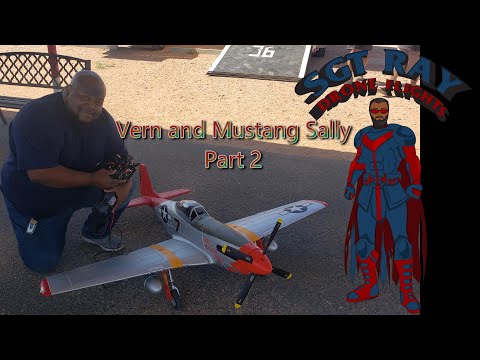
I did a flight on day one of the National Model Aviation day events in both Los Cruces NM and El Paso TX. And I went up with a P51 flown by the Prez of the Las Cruces club and his P51
Leave a comment:
-
I have the T28 and have flown it from bumpy dirt many times still on the original gear. It lifts off in short distance and can land gently. There are gear upgrades that people have done and I have a replacement gear ready to go should I need it. I am still getting plenty of enjoyment out of the stock gear. It's a fun plane, zero regrets!Leave a comment:



Leave a comment: