


I used Foam-Tac on the first one. I was going to fly today, pulled on the other before I loaded up and it popped out. 🙄 The two did not have the same glue which is very weird. The one that popped out today had a blob of what appeared to be canopy glue and maybe Foam-Tac or something similar. Might try Gorilla Glue on this one so I can see how I like it.
-
Thanks for your suggestions. I guess the issue for me is not whether it works places other than where I operate it. If I can do a range test from the center of the top of the empire state building with the aircraft being inside a bank vault sitting on the sidewalk and it works fine, it doesn't help the situation. I require the receiver to work at the field I fly from with the hedge. If it doesn't then I have to use one that does, irregardless of its stellar performance in other locations.Leave a comment:
-
-
-
-
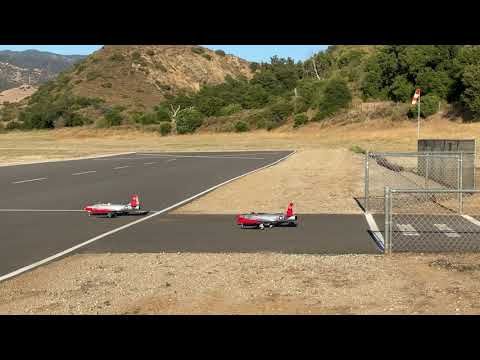
Sharing my friend’s formation video of our T-birds in formation. I was flying lead. Watch it in 4K on large screen. Credit: Aerocali
Leave a comment:
-
I'm way late to this party, but I just maidened my T-33 today. My hat's off to Motion and Freewing, this is a sweet flying model. It has plenty of speed if you want it, yet slows down for very smooth landings.
JBLeave a comment:
-
-
I have yet to have a retract come out on this plane, however, I've had to re-glue many other retracts back in on other planes (actually did one yesterday on an Eflite Phantom). When a retract comes out due to a bad landing or landing in the rough, foam is going to get ripped apart. Some will stay on the retract mount while some will stay on the wing side and some will get torn off and hang there in little hunks. If your retract doesn't slide right back into the slot it came out of smoothly, that means it's catching on bits of foam that's just hanging out of their natural location. You are then forcing the retract back against those little hunks that aren't in place. It's up to you to either find those hunks and glue them back in their places or yank them out entirely and forget about them. On all of the ones I've re-glued, there was no need to hold them in place. They just went in and stayed there, waiting for the glue to set. If yours needs holding in place, then I'd surmise that you didn't do your prep work first before putting the retract back in the hole.
Insofar as removing the one that didn't get ripped out, some people simply extend the gear, grab it and give it some good tugs to see if it'll rip out. If it comes out fairly easily, then you can do a better job of gluing it back in. I've never had one where I could tear it out by my own doing. If the retract is even 1/2 glued in well, it's going to take a pretty good impact to rip it out, likely far more than I would like to impart on the unit on my own at home. Just imagine the amount of force that the retract encounters "in the field" when it comes down hard or suddenly runs into a different type of terrain. Sorry, but I'm not willing to give it that kind of force by choice nor would I want to replicate that kind of sudden impact, not knowing if the retract has a lot of glue or just a little less glue than it should have. Each individual owner, of course, is more than welcome to "give 'er" and see what happens.Leave a comment:
-
When gluing the gear boxes in, how did you hold them in place? It takes a good bit of pressure to get them where they need to be in the wing. When removing the one that didn't come out do you just apply pressure until it comes out? Fix one and land in the grass to snap the other one off then repair? 🤣Leave a comment:
-
FWIW, I used clear Gorilla glue (non foaming type) when mine got loose. I have 50+ flights on grass and concrete since then and they are still rock solid. It's not a quick field fix but I've been impressed.Leave a comment:
-
I've used BSI Foam Glue (blue tube) with great success. On a structural point like this, I'd prefer that over CA which is susceptible to crack under repeated impact. Epoxy also tends to not stick super well to EPO.Leave a comment:
-
I got in two more flights today on my T-33. I'm still waiting on Y-connectors so the nose gear was an issue again. I did get it down in time.
I made a landing on the grass and one of the main gearboxes came out of the wing. It subsequently cut a nice design on the bottom of the fuselage and the airplane flipped and bent the vertical stab, so back in the shop. I'll have to pull the other main off and glue it was well. There was very little glue on the box and none had transferred to the foam. What glue are y'all using to glue these back in?
Attached FilesLeave a comment:
-
-
thank you radar-guy for putting the files
your work is fantastic
PaulLeave a comment:
-
Pilots
After some more flight with my T33, I removed blue box and LG reacts on switch now is much better.
Well my front gear was jammed again, it would not come out off the fuselage....., I fly from grass and pin in retract unit is weak for grass operation.
After some little pressure on LG when retracted I was able to get it out.
So I have to bend it back a little and after that I had 4 flight an no issues with front landing gear.
Also I noticed that this has in effect on steering of front gear, it didn't track right anymore before it was OK.
Luckily I have my steering on a separate channel so I trimmed it to go straight again.
grts HansLeave a comment:




Leave a comment: