Just got this bird set up for maiden, precoated everything with min wax prior to assembly, balanced as per manual my admiral 5000 50C rides-up on the foam ledge in front of the battery tray, is this kosher?
Got mine with this last shipment. I am not one to do too many mods other than power upgrades and occasional paint, but this one just screamed at me for lights for some reason. Landing light, nav lights and a beacon. I have one white led left so might add a strobe on the bottom.
]I ordered this yesterday afternoon, it showed up before noon today.[/B] I taxi tested before 4:00 today, ready to maiden. Only 25 hours from placing order to flight ready is a record for me. Thanks MRC for the quick delivery and a great kit. Went together quick with no issues. Looks great and everything works as it should. Hope to maiden tonight or tomorrow morning.
Been reading posts and haven't seen anyone having any issues other than gear coming out. I tugged on mine real good and seem solid so going to go with it. Appreciate it if anyone has any suggestions on setup. I went with what the manual calls for. I see some are moving CG rearward a little. Does this seem to be best? I am using Admiral 6S 5000mah 50C batteries. Thanks...
Wow that might be a record! Love the look of this bird.
There are also 3 or 4 pieces of weight added to the nose that's just dead weight you can remove with careful surgery if you'd like to get more battery in her for even longer flight times.
Youll see a silver tape just behind the CG mark that covers the servo wires. Most of us are balancing the t33 right in the middle of that tape.
I have 2 that are EDF and 1 that is turbine converted. They all fly great at that CG point.
I ordered this yesterday afternoon, it showed up before noon today. I taxi tested before 4:00 today, ready to maiden. Only 25 hours from placing order to flight ready is a record for me. Thanks MRC for the quick delivery and a great kit. Went together quick with no issues. Looks great and everything works as it should. Hope to maiden tonight or tomorrow morning.
Been reading posts and haven't seen anyone having any issues other than gear coming out. I tugged on mine real good and seem solid so going to go with it. Appreciate it if anyone has any suggestions on setup. I went with what the manual calls for. I see some are moving CG rearward a little. Does this seem to be best? I am using Admiral 6S 5000mah 50C batteries. Thanks...
Did shortening the main LG create any issues with the wheel well clearance when retracted? Or the door closing mechanism? Or is the lower squat all due to the Softer spring compression?
Just got notice that the Air Force T-33 is back in stock and ordered one last nite. I had chatted with Motion the night before with them saying it would be another thirty days, guess they were as surprised as I was! Can’t wait to get this bird up, hope it flys as good as my Avanti!
I'd say the most common wheel brakes now a days is from JP Hobby electric brakes. Just be sure to order the correct wheel size and wheel axle diameter.
The wheels with brakes are quite heavy, so check CG and adjust distributed weight via your LiPo to ensure your CG/CG range is where you want it after installing the wheel brakes. If there is some odd differential braking occurs between each wheel, the manufacturer has stated some fixes, as well as members have provided added detail if you need it when the time comes. Sometimes you get a pair that brakes evenly, or evenly enough. Also, be sure to connect the wheel brakes properly with polarity, voltage, and Transmitter activation for the desired brake force.
For the money, it's difficult to beat the JP wheel brakes. They are also rather widely available from many vendors due to their popularity, and in various wheel sizes and axle diameters.
This may have come up somewhere in the over 50 pages of discussion on the T-33, but if it hasn't, I wanted to ask if anyone has used wheel brakes on their planes to limit the ground roll on landing. The field I fly from has paved runways, but short and rough. Plus, it is at 5000 feet altitude, so approach speeds are a little faster than at sea level. My problem is that my plane, with no headwind has a tendency to roll through the end of the runway and into some pretty serious weeds and rough terrain when it occasionally departs the end of the runway at low speed. Even at these low speeds, I've had damage to the nose gear servo when the gear collapsed into a small hole. I strive to put the airplane at minimum speed, landing flaps, etc., but this plane just rolls forever, it seems. I don't have this problem with other planes I have that fly from this field.
So, if anyone has any tips for wheel brakes, what kind you use, how you hook them up, etc., that would be very much appreciated. I haven't ever installed wheel brakes before, but in this case for me, they're definitely warranted. Thanks!
I'd say the most common wheel brakes now a days is from JP Hobby electric brakes. Just be sure to order the correct wheel size and wheel axle diameter.
The wheels with brakes are quite heavy, so check CG and adjust distributed weight via your LiPo to ensure your CG/CG range is where you want it after installing the wheel brakes. If there is some odd differential braking occurs between each wheel, the manufacturer has stated some fixes, as well as members have provided added detail if you need it when the time comes. Sometimes you get a pair that brakes evenly, or evenly enough. Also, be sure to connect the wheel brakes properly with polarity, voltage, and Transmitter activation for the desired brake force.
For the money, it's difficult to beat the JP wheel brakes. They are also rather widely available from many vendors due to their popularity, and in various wheel sizes and axle diameters.
This may have come up somewhere in the over 50 pages of discussion on the T-33, but if it hasn't, I wanted to ask if anyone has used wheel brakes on their planes to limit the ground roll on landing. The field I fly from has paved runways, but short and rough. Plus, it is at 5000 feet altitude, so approach speeds are a little faster than at sea level. My problem is that my plane, with no headwind has a tendency to roll through the end of the runway and into some pretty serious weeds and rough terrain when it occasionally departs the end of the runway at low speed. Even at these low speeds, I've had damage to the nose gear servo when the gear collapsed into a small hole. I strive to put the airplane at minimum speed, landing flaps, etc., but this plane just rolls forever, it seems. I don't have this problem with other planes I have that fly from this field.
So, if anyone has any tips for wheel brakes, what kind you use, how you hook them up, etc., that would be very much appreciated. I haven't ever installed wheel brakes before, but in this case for me, they're definitely warranted. Thanks!
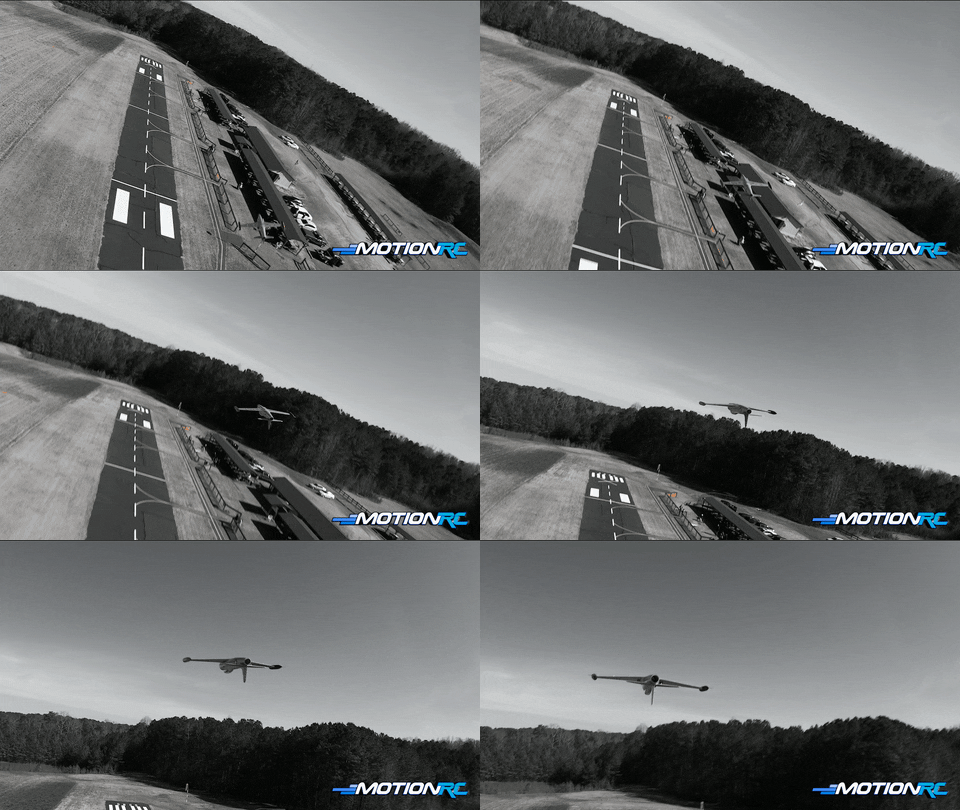
Nothing all too special about this picture. It just shows the return of the T-33 after completing flights #4-8 today. What is special however, is this jet. I want to express my absolute pleasure with my T-33 experience. It is a joy to fly. Our RC Club is at an elevation of 4500’, with a paved runway of 500’. The T-33 is a great performer, even at our altitude on a warm day. It’s speed range is wide. Stable in both slow flight as well as full throttle and high speed. It can be flown scale, or dial up the throttle and it gives powerful vertical performance. Precise 4 point rolls are beautiful. Landing approach is stable and predictable. I’m currently running Admiral 6s 5000’s with the timer set to 3:30. I have been typically landing at about the 4:00 mark. Batteries show 22.7-ish volts. And I tend to lay into the throttle, I like it fast. All around a great performer with no apparent bad habits whatsoever. Very pleased with the T-33. I will be purchasing another when they are back in stock. I don’t want
to be without one. Happy flying!
This observation is confusing to me. The connectors found on this plane was not an issue in terms of connecting to the receiver. I'm using a Spectrum compatible RX and all the plugs were standard types and were never a problem to insert. None had to be filed or shaved or even blessed with holy water to go in. Did you get an oddball plane? Or did you plug them in backwards?
I have had trouble with the jumper connections from the blue box to the RX as well as a few of the actual servo plugs on the installed servos. As mentioned above, the plastic of the MRC supplied connector is just a hair too large to slide into the Spektrum RX servo slots. No, we are not plugging the leads in backwards. Only aircraft I have with this issue so far are my 737 and both of my T-33s. Was not an issue on any of my other MRC aircraft, so not a universal problem. Likely a production batch issue with some of the connectors, possible a worn or slightly misaligned injection mold.
Still slowly plugging away at my T-33 to P-80 conversion. Most of the inlet rescupting is done. The rear wing fillets were removed and moved to the new loction.
I flat-topped the rear of the battery hatch, below the surface of the fuse. so that a new block of foam can be added and sculpted to match the upper fuse contour, in advance of adding the single place canopy. Clipped off the plastic wing tip mounts for the Fletcher tanks on the T-33 in preparation for the carved balsa wingtips for the P-80. Wingtip blocks ready to carve and install.
Ordered my markings for the P-80 from Callie on Sunday. After much consideration. I chose to use the markings for "Saggin Dragon", a P-80C that saw action in Korea. A fun scheme. Callie is running about a 6 week delivery on custom markings at this time, so perhaps I can time the project to be painted just in time for the markings.






Leave a comment: