My dx7 was purchased as a 7 channel only I had to upgrade it.to plus.. To b a 14. 7 of which r ghost as hugh calls em. Not that I no how to use them. Mr tech not
Rereading that post I made several errors, not surprisingly. The channels don't go up to Aux 20, only Aux 15, as channels 1-5 are assigned throttle/aileron/elevator/rudder/gear, depending on the aircraft type you input because if you don't use a standard wing type and say if you program 2 separate flap servos, 2 aileron servos, 2 rudder servos and 2 elevator servos each will show left and right and you'll have 4 less Aux numbers (still 20 in total) but you'll need a 10 plug in servo channel RX with that, minimum.
So my flaps end up on Aux 1, and with standard wing types the Aux channels go to 15.
Yes, exactly, that matches your explanation of the channels... but there's another one for the gyro control (theoretical channel), so as you wrote, you need at least 9 channels. Since 9-channel receivers are usually unavailable, Spektrum receivers always end up being a 10-channel model. How it can work with fewer channels, always including gyro functions, is beyond me.
All Spektrum gyro receivers actually have 20 channels. The 6/8/10 models have that many "plug in" channels, the rest are referred to as "ghost" channels. So things like gyro controls (such as in flight gain controls and FM) you can assign to a switch and it corresponds to Aux 7-20 (on the 6 channel RX). Only servo plug ins need to go in the 6/8/10 channels. Mixes can also be in ghost channels. 😱
If you have a 20 channel TX, all ghost channels show up all the way to Aux20. A 10 channel TX will only show up to Aux 10. That's why people buy 14 and 20 channel TX's. No 20 channel plug in servo RX's. With a 6 channel RX, you can always get a channel expander or 2 and take advantage of those 20 channels, as long as your TX has 20 channels.
These ghost channels also allow you to assign more than one thing to a single switch. For example, my flaps are assigned to channel 6, Aux 6 and assigned to switch D, a 3 position switch. I also assign ghost channel Aux 20 (or any other unused Aux channel) to the 3 position Switch D and assign Aux 20 as my 3 Flight Modes in the gyro setup. That way, when I deploy flaps, the gains increase with flap deflection that I set gains for flaps up fly around, increasing for take off flaps, and increasing for landing flaps. Gains change automatically as my flaps change. 😁
I do similar things like with the Aux channels assigning TV nozzles to a switch for on/off and tailerons to off/50%/75-100% with a 3 position switch, though the servos are plugged into specific channels.
I don’t use gyros and prefer Orange receivers. They make 9ch. Many could skip the separate steering, the person didn't ask about separate steering, and use a 8ch Spek with gyro being virtual. And many don't use Spektrum at all.
For you, using Spek and needing a gyro it makes sense.
Yes, that's right... I unfortunately didn't read all the comments completely, sorry.
I don’t use gyros and prefer Orange receivers. They make 9ch. Many could skip the separate steering, the person didn't ask about separate steering, and use a 8ch Spek with gyro being virtual. And many don't use Spektrum at all.
For you, using Spek and needing a gyro it makes sense.
Originally posted by EDF-Jetpilot
Yes, exactly, that matches your explanation of the channels... but there's another one for the gyro control (theoretical channel), so as you wrote, you need at least 9 channels. Since 9-channel receivers are usually unavailable, Spektrum receivers always end up being a 10-channel model. How it can work with fewer channels, always including gyro functions, is beyond me.
This was my reply when F4Ausie asked. Why is 10ch needed?
Yes, exactly, that matches your explanation of the channels... but there's another one for the gyro control (theoretical channel), so as you wrote, you need at least 9 channels. Since 9-channel receivers are usually unavailable, Spektrum receivers always end up being a 10-channel model. How it can work with fewer channels, always including gyro functions, is beyond me.
This was my reply when F4Ausie asked. Why is 10ch needed?
Originally posted by Evan D
I would never use that receiver in anything bigger than a 64mm jet. I believe in satellites. This jet is a 6ch jet without extra mixes like tailerons or flaperons. Throttle, ailerons, elevators, rudder and steering, retracts, and reverse. Add a channel for flaperons or tailerons and you have to remove one of the basic six. Want the basic six and flaperons = 7. Add tailerons = 8. Add separate steering = 9.
Firstly. Need to replace my ar631 Rx because I pull the 1 wire thru the fuse behind the latch then glue .. a mistake.. after near disaster.. was about to rotate and lost power,,around 25 meters from me... After range check. Discovering the 1 wire on rx had pulled out of itself.. lucky,, was b4 rotation...
I'm sure that happened. With flex in the fuse.. ifit was not glued it would not have pulled out.. anyway will replace. It. Sooo. Thinking about flaperons and tailerons.
Hope I got the correct names?? Will b a first setup 4 me like this ..and getting out of my comfort zone.. so can I do it with 6 channel Rx. Or is 8 req. I'm using an nx7 which has been upgraded for plus Rx s. Here is the best part. I have no god damb idea how to do it.. make it simple cause I'm stupid
.
And will it fly differently. And land slower :face_with_monocle: boy thatwas an effort on my fone. Thanx
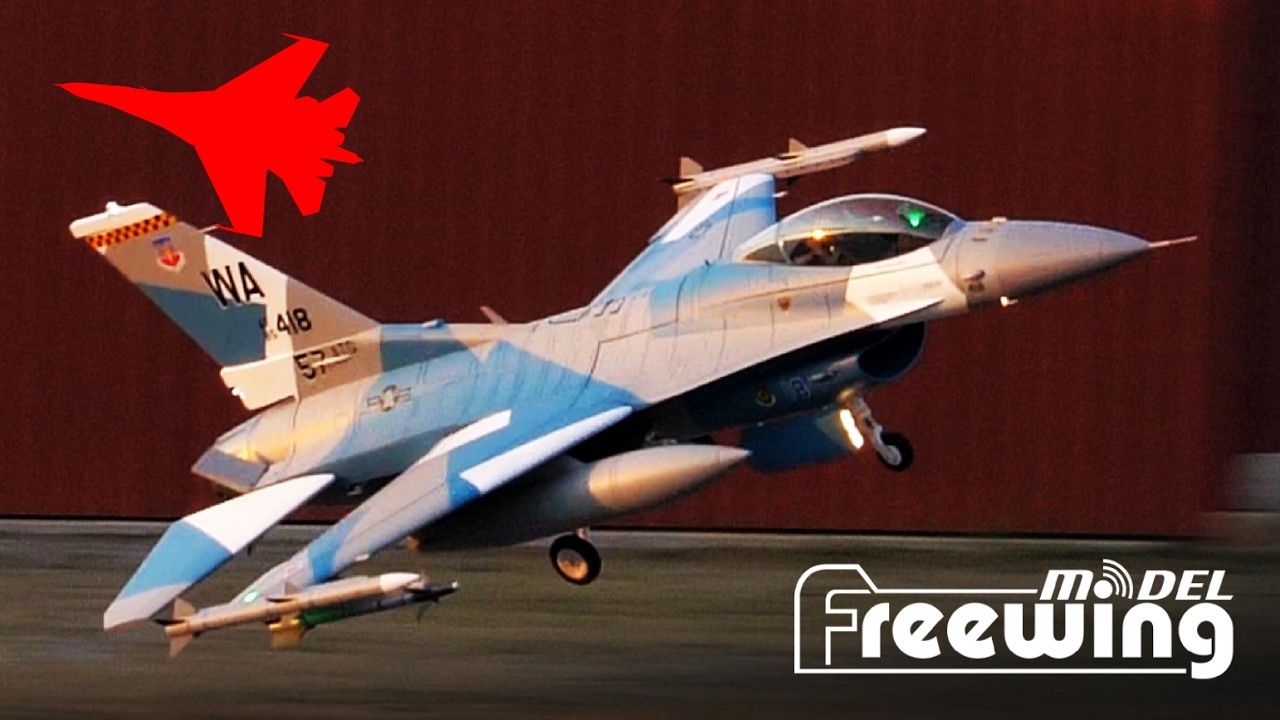
For the F-16 setup with tailerons/flaperons, you always need a 10-channel receiver. I use the AR10360T with AS3X+ and telemetry in all my EDF jets 80mm and larger. It makes programming everything very easy, including fine-tuning the gyro – a dream setup for the F-16. I fly them all with tailerons/flaperons. Once you've flown it, you won't go back!
Outstanding flying, as usual, and beautiful landing. Have to complement the video work as well, first class and excellent time of day to really show it off
🤙
Another way to achive a good reverse option on the TX 16 is to use a logical swithch. I have one that is active only when the gear is down and the REV thrust switch is selected.
When i select my switch for reverse it activates the reverse channel and then the Logical switch overides the Throttle channel to a set amount and provides me with reverse, When done, flick the switch back to FWD thrust.
Same here. However, I've found lately that RCC don't seem to keep stock of the Lemon RXs that I want. That being the case, I've found that I can get them directly from Lemon Online for about the same price. I also have a Canadian online shop that carries the Lemon line but again, they don't always have good stock. In fact, Mr. Mailman brought my Lemon 10-ch from G. Hobbies today. Same price, same delivery time as Lemon and RCC.
Like to ask one last if I can. If U use a compatible receiver. And satellite. Do u adjust the gyro(as3x). Settings in the same way
My answer will be from a different perspective in case that's what your question is about. In the Lemon brand, the gyro gain numbers don't parallel those in Spektrum AS3X RXs. Eg. In Spektrum, gain numbers for a typical fast jet in "roll" can be in the 50 to 60 range prior to oscillation in that axis. Lemon, by contrast for the same axis, typically use gains in the 30 to 35 range.
With current Spektrum RXs, adjustments and settings can easily be done by "forward programming" directly from the TX. Most new, unlocked Spek RXs come with pre-set gains. There is a small learning curve involved in knowing how and what to do but after doing a couple, it becomes very easy. Spektrum has a lengthy series of YouTube videos detailing various instructions.
From the Lemon standpoint, most come with gain pots (3) that are pre-set at about 50%. Stabilization must be "activated" or the RX acts like a normal non-stabilized one. 50% is generally way too much for most planes except very slow ones like a slow sailplane, so gains must be dialed down by changing the pots or using a switch to set a fraction of the default percentage or a master gain knob to dial down the gain on the fly. (Spektrum allows you to do this, too.) Setting RX parameters is done by knowing what the little lights mean and what to do when the light sequence you see is what you need to do a change. This involves button pushes on the RX itself. Again, a bit of a learning curve but can become easier with practice. Lemon products do NOT come with instructions. You must go the various sources, one of which is Lemon Online, to download a "manual" for your specific product.
Unfortunately, Orange products are hard to get for me. HobbyKing will not ship many of their products to Canada. I have used Orange in the past and I quite liked them. Good, reliable tech, very reasonable pricing. I am currently trying to purchase a plane from them and I am told that their logistics people have to go in and actually revise the SKU for that product so that it can be shipped to Canada. That's how messed up their system is for us.
As already stated, a remote satellite RX is almost compulsary for today's planes with all their electronic wiring and rats nest of cabling, not to mention the higher voltage that is typically encountered.

 calls em. Not that I no how to use them. Mr tech not

.png)



 anyway will replace. It. Sooo. Thinking about flaperons and tailerons.




Leave a comment: