
P-38 - The Ultimate EPO Lightning

You must Sign-in or Register to post messages in the Hobby Squawk community
Registration is FREE and only takes a few moments

Register now

Announcement

Collapse
No announcement yet.

Rumors of Future Releases

Collapse
X
Collapse
First Prev Next Last
 
  • Filter
  • Time
  • Show
Clear All
new posts

  • Originally posted by Max-U52 View Post
    If the lower hull with tortion bar suspension is of sufficient quality, perhaps you could mate it with a heng long or trumpeter upper and Turret? Maybe both, even, if you have deep pockets? This is one area where building RC tanks is kind of like building muscle cars. Really nice tanks cost money, how nice do you want yours to be? That doesn't sound as cool as "Speed costs money, how fast you wanna go?", but I think you know what I mean.
    😸
    Heng Long markets an all metal M1A2 Abrams lower chassis if cost is no objection.

    What I am looking for is an inexpensive 1/16 scale Abrams with torsion bar suspension and well fitted suspension arms. I hope that it has to scale sprocket and track so that I can use the Tamiya track on it. From the Tongde M60 upgrade experience, I hope that one of the TD Abrams can meet my expectations as an upgrade starting point.

    Comment


    • Originally posted by keilau View Post
      The size of the sprockets do not matter. Here is the equations for calculating the 1/16 scale tank speed.
      1. motor rpm x gearbox ratio = track rpm
      2. track rpm x track length (inches) = actual RC tank speed in in/min
      ​When you use a larger diameter sprocket, you need to increase the track length to go around it. A longer track means faster tank speed. It is simple mathematics. Please, let me know how my equations were wrong if you are not convinced.
      Hi, I know this is a few replies ago, but I couldn't just read this and not correct it. You're completely missing a step in your equations. Namely, motor rpm x gearbox ratio DOES NOT EQUAL track rpm. Motor rpm x gearbox ratio gives you the drive sprocket rpm, which is NOT the same as track rpm.

      Drive sprocket rpm converts to track rpm by the ratio of drive sprocket circumference to track length.
      For example, a 1 inch diameter drive sprocket (3.14in circumference) will turn roughly 10 times for one full revolution of a 30inch long track. In this way, like SoCalBobS mentioned, the drive sprocket can be seen as the final gear in the drive train.

      This means that a drive sprocket twice as large in diameter will make the tank drive twice as fast.

      This fact illuminates the other incorrect claim you made, "When you use a larger diameter sprocket, you need to increase the track length to go around it. A longer track means faster tank speed."
      For the same tank chassis, say 15 inches long, going from a 0.5inch sprocket to a 1inch sprocket won't increase the total track length by more than 2 inches, so by your reasoning you'd only see a speed increase of 2/15 or ~13%, when in fact this change will make the tank twice as fast. The tradeoff is that the tank will have half the amount of torque (and thus acceleration) at the ground, and will take longer to reach that top speed.

      All of this is taking an unnecessary detour though, the track length itself is actually irrelevant. The drive sprocket in a tank functions no differently than the wheel on an rc car, and we know that at equal drive shaft rpms, a wheel twice the size will make the car go twice as fast. To convince yourself of this fact, imagine if you lowered or compressed the tank until the drive sprocket was in contact with the ground. Now the track is effectively just another layer of pavement, and the drive sprocket rolls without slipping along the ground, the same that a driven wheel on a car would.

      Equations:
      Motor rpm * gearbox ratio = drive sprocket rpm
      (drive sprocket circumference / track length) * drive sprocket rpm = track rpm
      track rpm x track length = rc speed.

      Putting it together:
      Motor rpm * gearbox ratio * (drive sprocket circumference / track length) * track length = rc speed.

      notice how track length cancels out since it is in the numerator and denominator of the combined formula.

      Comment


      • Originally posted by LegoDEI View Post

        Hi, I know this is a few replies ago, but I couldn't just read this and not correct it. You're completely missing a step in your equations. Namely, motor rpm x gearbox ratio DOES NOT EQUAL track rpm. Motor rpm x gearbox ratio gives you the drive sprocket rpm, which is NOT the same as track rpm.

        Drive sprocket rpm converts to track rpm by the ratio of drive sprocket circumference to track length.
        For example, a 1 inch diameter drive sprocket (3.14in circumference) will turn roughly 10 times for one full revolution of a 30inch long track. In this way, like SoCalBobS mentioned, the drive sprocket can be seen as the final gear in the drive train.

        This means that a drive sprocket twice as large in diameter will make the tank drive twice as fast.

        This fact illuminates the other incorrect claim you made, "When you use a larger diameter sprocket, you need to increase the track length to go around it. A longer track means faster tank speed."
        For the same tank chassis, say 15 inches long, going from a 0.5inch sprocket to a 1inch sprocket won't increase the total track length by more than 2 inches, so by your reasoning you'd only see a speed increase of 2/15 or ~13%, when in fact this change will make the tank twice as fast. The tradeoff is that the tank will have half the amount of torque (and thus acceleration) at the ground, and will take longer to reach that top speed.

        All of this is taking an unnecessary detour though, the track length itself is actually irrelevant. The drive sprocket in a tank functions no differently than the wheel on an rc car, and we know that at equal drive shaft rpms, a wheel twice the size will make the car go twice as fast. To convince yourself of this fact, imagine if you lowered or compressed the tank until the drive sprocket was in contact with the ground. Now the track is effectively just another layer of pavement, and the drive sprocket rolls without slipping along the ground, the same that a driven wheel on a car would.

        Equations:
        Motor rpm * gearbox ratio = drive sprocket rpm
        (drive sprocket circumference / track length) * drive sprocket rpm = track rpm
        track rpm x track length = rc speed.

        Putting it together:
        Motor rpm * gearbox ratio * (drive sprocket circumference / track length) * track length = rc speed.

        notice how track length cancels out since it is in the numerator and denominator of the combined formula.
        LEGO are you still an engineer at JPL or did you move over to Space X yet?

        Comment


        • I'm still hanging at JPL haha, trying to avoid getting laid off 😅

          Comment


          • Lego, you're right. Thanks.
            The more screws it takes to reassemble a tank, the more likely it is you left something out!

            Comment


            • Originally posted by LegoDEI View Post

              Hi, I know this is a few replies ago, but I couldn't just read this and not correct it. You're completely missing a step in your equations. Namely, motor rpm x gearbox ratio DOES NOT EQUAL track rpm. Motor rpm x gearbox ratio gives you the drive sprocket rpm, which is NOT the same as track rpm.

              Drive sprocket rpm converts to track rpm by the ratio of drive sprocket circumference to track length.
              For example, a 1 inch diameter drive sprocket (3.14in circumference) will turn roughly 10 times for one full revolution of a 30inch long track. In this way, like SoCalBobS mentioned, the drive sprocket can be seen as the final gear in the drive train.

              This means that a drive sprocket twice as large in diameter will make the tank drive twice as fast.

              This fact illuminates the other incorrect claim you made, "When you use a larger diameter sprocket, you need to increase the track length to go around it. A longer track means faster tank speed."
              For the same tank chassis, say 15 inches long, going from a 0.5inch sprocket to a 1inch sprocket won't increase the total track length by more than 2 inches, so by your reasoning you'd only see a speed increase of 2/15 or ~13%, when in fact this change will make the tank twice as fast. The tradeoff is that the tank will have half the amount of torque (and thus acceleration) at the ground, and will take longer to reach that top speed.

              All of this is taking an unnecessary detour though, the track length itself is actually irrelevant. The drive sprocket in a tank functions no differently than the wheel on an rc car, and we know that at equal drive shaft rpms, a wheel twice the size will make the car go twice as fast. To convince yourself of this fact, imagine if you lowered or compressed the tank until the drive sprocket was in contact with the ground. Now the track is effectively just another layer of pavement, and the drive sprocket rolls without slipping along the ground, the same that a driven wheel on a car would.

              Equations:
              Motor rpm * gearbox ratio = drive sprocket rpm
              (drive sprocket circumference / track length) * drive sprocket rpm = track rpm
              track rpm x track length = rc speed.

              Putting it together:
              Motor rpm * gearbox ratio * (drive sprocket circumference / track length) * track length = rc speed.

              notice how track length cancels out since it is in the numerator and denominator of the combined formula.
              LegoDEI , thank you for correcting my huge mistake. That's what a 7 years retirement can do to a used to be sharp mathematics mind. I never used those equations to calculate the track rpm and should not have list them. Much less arguing that others were wrong. A big red face.

              After I complete my RC tank, I tested different 380/390 motors. The tank was put on a 2x4 dynamo. I use a hand held tachometer to measure the track rpm and calculate the scale speed. Below is a table of the 1/16 scale Heng Long Pershing with a Torro series 2 gearbox. Just an example.
              Click image for larger version

Name:	trackrpm-mph_Pershing.jpg
Views:	645
Size:	123.6 KB
ID:	404356

              Comment


              • Just a heads up on the Stuart tanks. It shows that it was flown over and is getting closer. Shows arrived shipping partner facility USPS awaiting item Canal Winchester, which is about 30 miles away.

                Comment


                • Originally posted by Milspec1 View Post
                  Just a heads up on the Stuart tanks. It shows that it was flown over and is getting closer. Shows arrived shipping partner facility USPS awaiting item Canal Winchester, which is about 30 miles away.
                  My twin Stuarts arrived today... :)

                  Comment


                  • Lucky!

                    Comment


                    • Just to add to the scale speed discussion. Scale speed can be found out using the below formula.

                      Apparently mathematicians. And engineers who build boats for use in test tanks use this formula for obtaining scale speed.

                      SS=RS/SQRT(S

                      SS=Scale speed

                      RS=Real speed

                      S=Scale

                      To calculate a scale speed, divide the real speed by the square root of the scale.

                      How accurate would this formula be? My view is if boat designers use it, must be right?

                      Most people on FB have decided that to get scale speed, you just divide by 1/16. So a full size tank covering 16km in one hour is travelling at 16kmh. Their logic is a 1/16 tank will travel at 1kmh as 1km is 1/16 of 16km.
                      ​
                      So I am asking for an intelligent response or explanation.

                      Comment


                      • I use a slightly different method. A scale quarter mile is 82.5 feet. I cross the starting line at full speed and then time how long it takes the tank to travel a scale quarter mile and then do the math from there. Trying to remember exactly how this goes but I think if you cover the 82.5 feet in 15 seconds it's a scale 60 miles per hour. Not the most precise method, but it works for me. Then there's the whole time thing, some people say you need to scale the time as well but I like to keep it simple.

                        Comment


                        • Perhaps scale speed discussion deserves its own thread? And, there is a thread for the Stuart once you have one (or two!) in hand..
                          The more screws it takes to reassemble a tank, the more likely it is you left something out!

                          Comment


                          • M5 Stuart? Ho hum, old news.

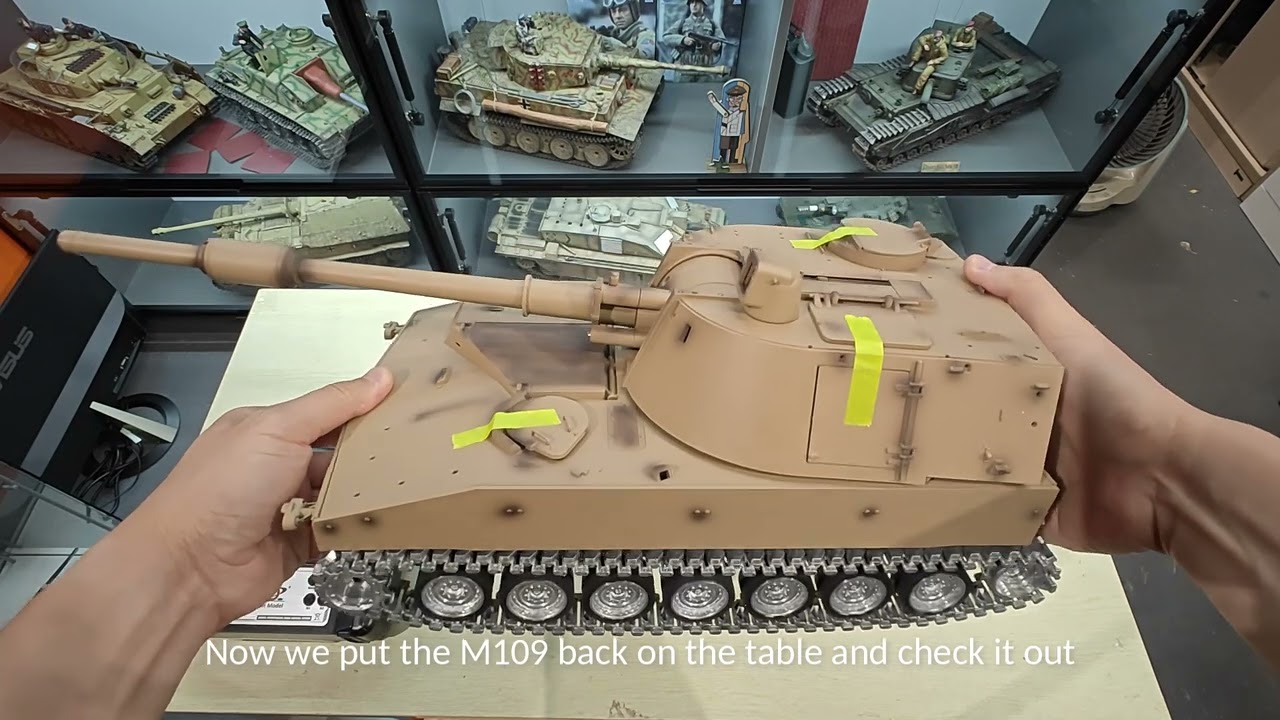
                            DKLM RC on FB states the M109 is ready for pre-order. However, there is no price listed or release date. Some old and new photos:

                            Click image for larger version  Name:	M109 02.jpg Views:	0 Size:	90.0 KB ID:	404779 Click image for larger version  Name:	M109 01.jpg Views:	0 Size:	83.2 KB ID:	404784 Click image for larger version  Name:	M109 06.jpg Views:	0 Size:	75.8 KB ID:	404783 Click image for larger version  Name:	M109 03.jpg Views:	0 Size:	154.3 KB ID:	404785 Click image for larger version  Name:	M109 07.jpg Views:	0 Size:	68.4 KB ID:	404777 Click image for larger version  Name:	M109 11.jpg Views:	0 Size:	96.8 KB ID:	404778 Click image for larger version

Name:	M109 10.jpg
Views:	536
Size:	141.2 KB
ID:	404780 Click image for larger version  Name:	M109 05.jpg Views:	0 Size:	94.2 KB ID:	404781 Click image for larger version  Name:	M109 08.jpg Views:	0 Size:	105.1 KB ID:	404782
                            The more screws it takes to reassemble a tank, the more likely it is you left something out!

                            Comment


                            • Found this on the Tongde website. I suspect a slight language problem. Panther 3 ?


                              Click image for larger version

Name:	P1.png
Views:	379
Size:	157.4 KB
ID:	404797

                              Comment


                              • FYI, as of 6/24 DKLM RC has posted an unboxing video of Tongde's M109 SP Howitzer. He estimates general release by mid-July

                                The more screws it takes to reassemble a tank, the more likely it is you left something out!

                                Comment


                                • I just don’t see a use for the m109 paladin for IR tank battles. No appeal at all especially since it’s not a tank at all, it’s just tracked artillery. Maybe if you like firing airsoft BBs it might be fun launching them far like artillery and trying to hit targets but just not useful for IR battles.
                                  RC tank parts and accessories I make
                                  www.RichardSJohnson.net/id28.html

                                  Comment


                                  • Hadn't thought about lobbing, that'd be cool. I guess not everyone is focused on IR. I see 1/16 models on European forums that are hyper detailed but never see the light of day.
                                    The more screws it takes to reassemble a tank, the more likely it is you left something out!

                                    Comment


                                    • Originally posted by SoCalBobS View Post
                                      I guess not everyone is focused on IR.
                                      Bill, who owns Imex, told me that 80% of all the tanks he sells are airsoft.

                                      Comment


                                      • Does anyone know what the gear ratio is for the new m60a3 tank

                                        Comment


                                        • Originally posted by Mulehcmc1@gmail.com View Post
                                          Does anyone know what the gear ratio is for the new m60a3 tank
                                          If I remember correctly it's ~33:1.

                                          Comment

                                          Working...
                                          X