-
-
Been loving flying this little ripper the last few months. I recently changed the fan to a twelve blade and it went very quick. Though on the second flight I lost orientation briefly and she went in hard. The damage looked quite bad with a broken wing, fan case, spar, and the internal ducting was messed up, so I promptly ordered a replacement.
after a bit of gluing I managed to repair the original one, but as the ducting was messed up I put a small quad motor on the back to see if she would fly again.
In the meantime the new one arrived, so I took two to the field at the weekend.
Weather was a bit windy so only managed one flight on each. The prop powered one was a little tail heavy, but will fly again next time with the battery further forward, and the new one flew as expected.
I have got a new twelve blade fan to fit at some point as well.Attached FilesComment
-
-
All you did was put a twelve blade fan in it?Comment
-
Sorry no ,I bought the full unit,fan,housing and motor.This one- EDF4300KV 3S
Comment
-
Also upped the esc.Comment
-
I went to give my Lippisch P.15 her maiden flight but had trouble balancing her. My setup is a Lemon RX with an Admiral 1600 MAH 3S battery. Question is, when balancing her, do you do it when upside down or right side up. I was doing it right side up and it was always nose heavy. Someone suggested the correct way to balance was to turn her upside down like balancing a low wing airplane. Any thoughts on this?Comment
-
Either way is accurate. when you balance any object on two points, the object's center of mass (CG) will occur somewhere on a vertical plane passing through these two points. (But as you have noted, it may be difficult/impossible to get it to balance one way up - where the CG is above a line connecting the two balance points.)Comment
-
Seabee87 Upside down at the intersecting panel lines is where I balance mine. And then I also programmed a few degrees of up elevator to my usual takeoff flap switch. It helps a lot with rotation or hand launch with the Lippisch. Total deflection is the width of the trailing edge of the control surface.Comment
-
Seabee87 Also, I use a 2200 with it wedged up at an angle in order to CG correctly. And dial down the throws and add some expo. It's a fun little plane once you trim it out. Also be aware of the low passes and it's tendency to dive when full throttle is applied. For example a go around, without the takeoff elevator deflection. This plane floats forever and it's easy to miss the landing mark. I had read about it but didn't believe how significant the nose dip is when punching the throttle. Aside from the minor quirks the plane is amazing.Comment
-
Now that you mention this, it all comes back to me now. Thrust angle of the exhaust tube right through to the nozzle opening was directing the air DOWN. A few owners, myself included, reamed out a bunch of foam at the top of the exhaust opening to direct more of the exhaust upward, thus helping to push the tail down. I also added a clear piece of overhead projector film to the bottom half of the exhaust opening to prevent air from going down. It looked a bit like an upside down baseball cap beak. This virtually eliminated the dive upon sudden full throttle application.Comment
-
A couple of flights today with the pusher prop P15 with a Cobra CP2210/2200 AND 5X4 prop.First flight was a little tail heavy and twitchy.Second flight got it dialled in a little better with CG further forwards and expo up to 50% .I`m kinda likin the pusher version.
Comment
-
Not sure if those links are working: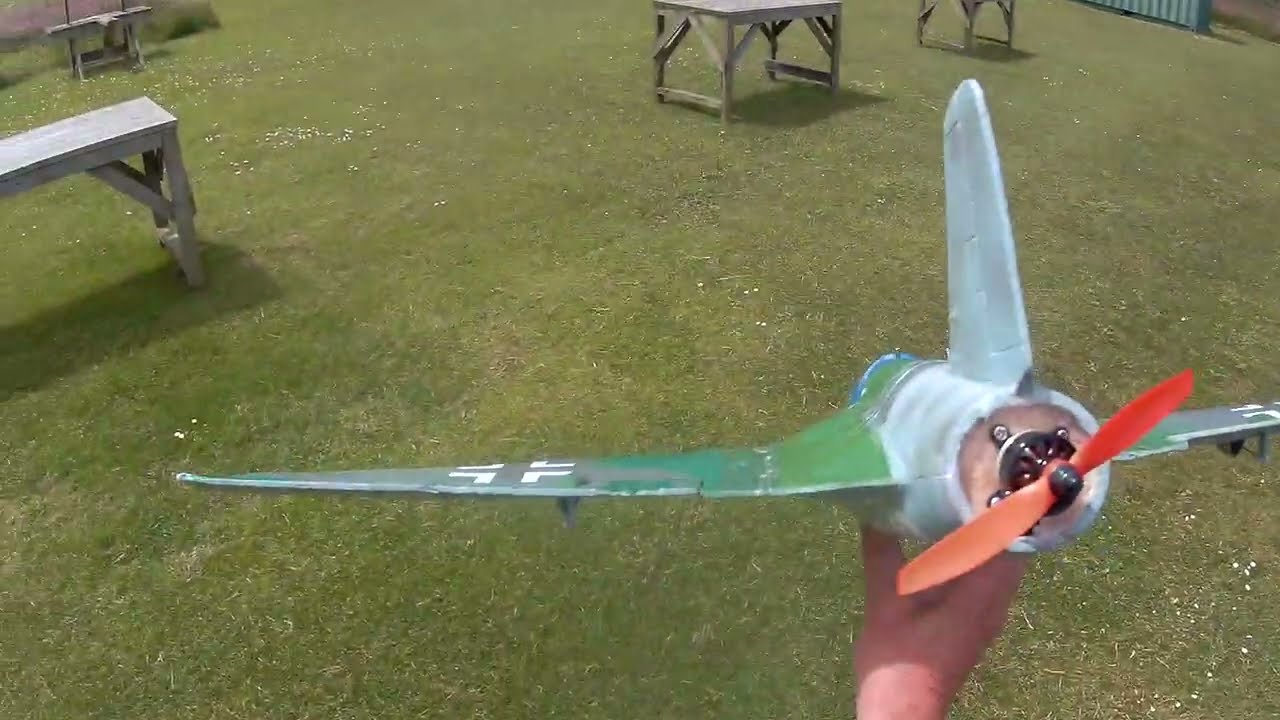
Comment
-
and
Comment
-
The old prop driven P15 got a new paint job at the weekend. Both flying greatAttached FilesComment
-
-
Not my best flying as I was still trying to calm her down,but heres a little video from the P15 pusher with DJI pan setup on board.
This thing flies great !
Attached FilesComment
-
-
Bonjour .testé ce matin 2 vol ca pousse fort EDF en 64mm .deco a l'aérographej'ai rajoute la commande de dérive. pas encore testé ce week end ; ).3s amiral 1800mah récepteur spektrum AR 631 avec Gyro intégréComment
-
Trying to keep up with a very fast Funjet with my P15 pusher.Also had the stock fan P15 out flying LOS:

Comment




Comment