
You must Sign-in or Register to post messages in the Hobby Squawk community
Registration is FREE and only takes a few moments

Register now

Announcement

Collapse
No announcement yet.

Official Nexa OV-10 Bronco 1800mm ARF Discussion Thread

Collapse
X
Collapse
First Prev Next Last
 
  • Filter
  • Time
  • Show
Clear All
new posts

  • TwistedGrin
    replied
    Motor comparison,

    In the original MotionRC video by James....he states he had the Admiral GP20 motors with 16x9 props power by dual 4s LiPo and cruising at 50% throttle. This would be nice.....but the GP20 motors are rated at 295Kv......so at 14.8v that's roughly 4366rpm:

    Just for comparison here are some numbers......
    Admiral GP20 296Kv x 14.8 = 4366 rpm
    Admiral GPS 4220: 770kv x 14.8v = 11396 rpm
    Admiral GPS 4220: 770Kv x 18.5v = 14245 rpm
    E-Flite Power 52 590Kv x 22.2v = 13098 rpm

    We all know the Watts / Amp loads vary with battery to prop sizes for thrust. But I can't figure out if I could throw a 16x9 on the E-Flite Power 52 590Kv x 14.8v = 8732 rpm and have a long running set up?

    TwistedGrin
    Attached Files

    Leave a comment:


  • TwistedGrin
    replied
    If you felt a disturbance in the Force last night - it was me as I allowed my pull string to the Elevator servo wire fall out....God Save the Queen, Bob's your Uncle and other terms of endearment flowed for quite awhile until I managed to find another means of pulling that servo wire through the vertical stab. I wanted to stay on the side of the servo lead orientation if possible.

    I also deployed ball joint clevis's to the rudders, my control rods were pretty soft so I deployed carbon fiber tubes to prevent any bending to those rudder control rods. Also I am deploying larger servo arms all the way around except for the flaps.

    TwistedGrin
    Attached Files

    Leave a comment:


  • TwistedGrin
    replied
    Gents,

    Just posting up some personal observations regarding the ProFly OV10:

    Recommended Servo arms are short:
    I have observed in my early stages of assembly...the MotionRC recommended Hitec HS-85BB servo arms are so short...they don't meet the assembly manual recommended length of 16mm from center to outer hole of the servo arm.

    Small servo arms only provide 12mm of travel:
    On my assembly this translated to a total travel of 12mm on the Aileron surface. This is the assembly recommended travel....but even then the linkage hardware is a nats hair above the servo mounting plate.

    Longer servo arms provide at least 20mm travel:
    I was able to find a longer servo arm that fits on the Hitec HS-85BB servo head....it is the recommended 16mm length from center to an outer hole. This sets up the Aileron surface to travel at least to 20mm...thus a "High" rate is achievable over the low rate 12mm.

    Additional stress on the servo with longer arms:
    I hope the additional distance from center does not cause over tork of the HS-85BB Mighty Micro servo's.

    You may not receive the (2) 500mm control rods required:
    Next: In my kit there is no 500mm control rods needed for the rudders. I am having to make my own.

    The shorter HS-85BB servo horns work for the flaps:
    The flaps can use the servo horns that come with the HS-85BB servo's since we set the servo horn with enough bias angle (60degrees) for Neutral Flap position (UP)...the required rotation for flaps down to 20mm travel is achievable without any hardware interference.

    Might look for a different size servo package:
    I would check for a larger servo that would fit this airframes servo pockets that has a longer servo arm if I were to do this model over.

    CA Hinge deployment - Your build technique depends on the materials:
    One more detail to cover. In MotionRC's build video by James for his surface hinge deployments....he suggest to drop in some CA then push them into position. What he does not detail is the type of CA he is using.....must be a slow dry. If you use standard thin CA the bond will be nearly instantaneous you will certainly NOT be able to re-position the hinges after dropping on the CA. Therefore be sure to insert the hinge / control surface all the way as desired - then drop in the CA for the instantaneous bond!!

    TwistedGrin
    Attached Files

    Leave a comment:


  • OV10
    replied
    Originally posted by TwistedGrin View Post
    Gents...I found a drawing to help make a dual battery dual ESC Parallel system cable

    TwistedGrin
    Thanx for posting the ol' standard TG.
    The 4th one down is the most typical configuration going.

    Leave a comment:


  • TwistedGrin
    replied
    Gents...I found a drawing to help make a dual battery dual ESC Parallel system cable

    TwistedGrin
    Attached Files

    Leave a comment:


  • WrightBrosRC
    replied
    Originally posted by Rosytime View Post
    I'm never to old to learn something. WrightBrosRC, I watched the video and researched on the ole interweb. I found out that you can lengthen the motor wires as you said. So much for those experts in my club. I will keep that in mind next time I have a situation that requires longer wires than what comes on the ESC. My ESCs are in the motor pods so the system I used was appropriate. Also, my batteries are wired such that both supply the ESCs equally. I had to make my own adapter and I agree with OV-10 that I would rather have all the juice going to both motors than to have one lipo sag and slow that motor down. I'm also going to try and S-BUS my servos and ESCs so that I have only one wire coming out of the wing along with the power wires. It's a rat's nest in my fuselage currently and I transport the fuselage with the wings on. Luckily I have a trailer to put my planes in.
    I learn new things about this hobby all of the time. I don't think anyone could know all of it so I rely on my flying mates too, good or bad. I didn't realize the battery side can be extended as well, it just demands more effort, math (calculation), components and risk compared to the motor side. I also agree with the battery sharing to both motors. Reasonably attainable redundancy is hard to argue with.

    Leave a comment:


  • Rosytime
    replied
    I'm never to old to learn something. WrightBrosRC, I watched the video and researched on the ole interweb. I found out that you can lengthen the motor wires as you said. So much for those experts in my club. I will keep that in mind next time I have a situation that requires longer wires than what comes on the ESC. My ESCs are in the motor pods so the system I used was appropriate. Also, my batteries are wired such that both supply the ESCs equally. I had to make my own adapter and I agree with OV-10 that I would rather have all the juice going to both motors than to have one lipo sag and slow that motor down. I'm also going to try and S-BUS my servos and ESCs so that I have only one wire coming out of the wing along with the power wires. It's a rat's nest in my fuselage currently and I transport the fuselage with the wings on. Luckily I have a trailer to put my planes in.

    Leave a comment:


  • WrightBrosRC
    replied
    Originally posted by OV10 View Post

    As a RF EE in my younger years...
    Ha! I'm retired FC from nuke cruiser days. We may have worked on some similar gear in our past?

    Leave a comment:


  • sam51401
    replied
    Can anyone point me to a suitable plastic lens, tear dropped shape, clear or red, that I can heat and mold or is preshaped for the two anti collision beacons.
    Attached Files

    Leave a comment:


  • OV10
    replied
    Originally posted by WrightBrosRC View Post

    The ESC information I eluded to in my video is fact based upon electrical science. While I did not explain the details of it, I did also recommend that you do your own research to discover the facts on your own.

    Why do you suppose Castle purposely sells capacitors for the battery side of the ESC and specs on wire length? Because their engineers know of this science too and they are trying to help you not to burn up your ESC! LOL

    If you want to go with what you know, "This is not the first plane that I have had to do this so I know it works." VS electrical science, its all you my friend. Happy flying!
    Totally concur with your polite sage advice. As a RF EE in my younger years, it sometimes gets frustrating trying to help those misinformed to understand the science fundamentals.
    The way you did your ESC configuration is rock solid with the science. I do ALL my twins the same way. I also do not have separate power to each motor...…….definite recipe for the proverbial one engine loss graveyard spiral with separate batteries to the motors.
    I always parallel ( Y the ESC power leads and the battery leads) on twin power so that both the ESC's see the same voltage through out the power/current supply cycle. If one battery collapses in the parallel setup the other good battery will continue to provide power (albeit for a much shorter time) until both ESC's hit low voltage cutoff and both motors quit together. It is much easier to recognize a dead stick situation than a single flame out and recover.
    Best regards,

    Leave a comment:


  • MikeT
    replied
    I installed the CC Caps after researching it and reaching out to castle for more information.


    Click image for larger version  Name:	IMG_2545.JPG Views:	0 Size:	135.7 KB ID:	233419. .

    Mike

    Leave a comment:


  • WrightBrosRC
    replied
    Originally posted by Rosytime View Post
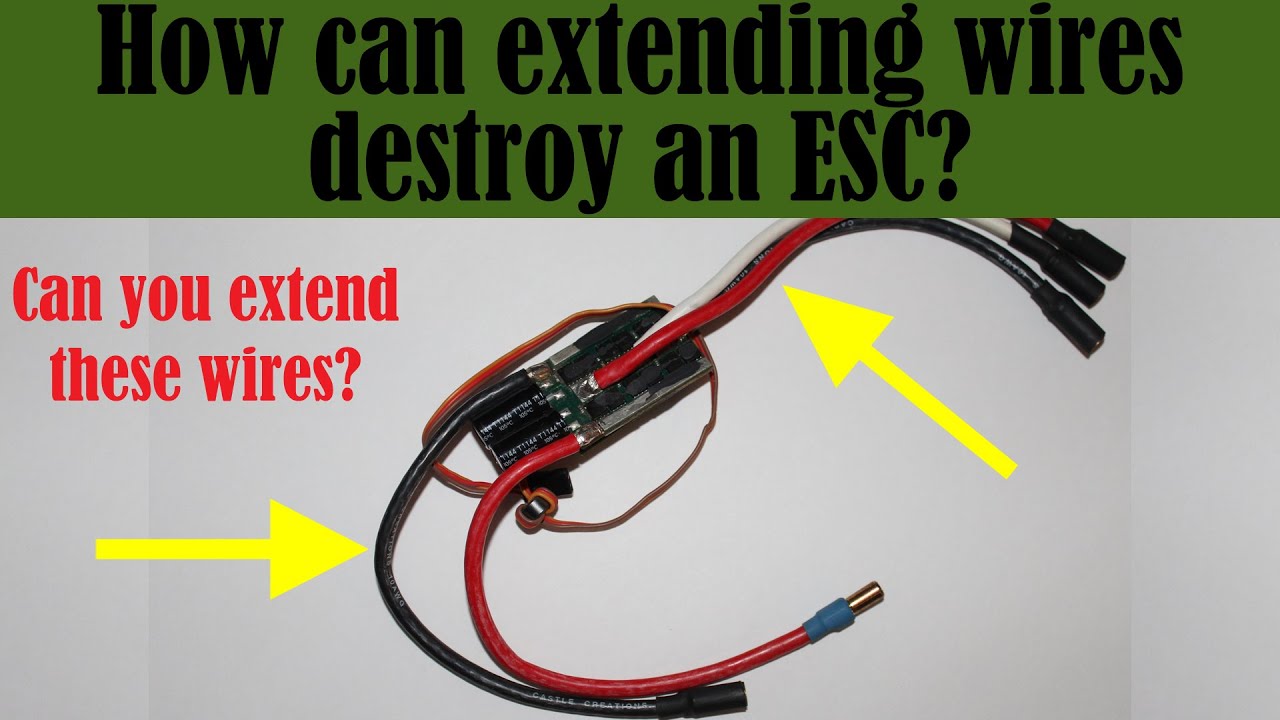
    I was watching WrightBrosRC video on your build. Very impressive and much more detailing and mods than mine. My only concern is how you are powering the motors. By putting the ESCs in the fuselage and running long wires to the motor is contrary to what the research I have done says. In fact if you go to the Castle RC site, they sell capacitors that you put in the battery side of the ESC. In the directions, they even tell you how long the wires can be before the Cap packs are needed. All info I have found is that you never lengthen the ESC to motor wires because of increased resistance in the wire as it gets longer. In my Bronco I used the ESC set up out of a Freewing A10. It has 100 amp ESCs, a BEC, capacitors in line, RF chokes, and long enough leads to not have to lengthen any leads. I use EC5 connectors and multi servo connectors to connect the pylons to the wings. This is not the first plane that I have had to do this so I know it works. I do know that we have had a few fliers do what you have done, long wires to the motor from the ESC, and ultimately the motors burned up. I will say that those were EDFs but the theory is still the same. Just my two cents
    The ESC information I eluded to in my video is fact based upon electrical science. While I did not explain the details of it, I did also recommend that you do your own research to discover the facts on your own.

    Why do you suppose Castle purposely sells capacitors for the battery side of the ESC and specs on wire length? Because their engineers know of this science too and they are trying to help you not to burn up your ESC! LOL

    If you want to go with what you know, "This is not the first plane that I have had to do this so I know it works." VS electrical science, its all you my friend. Happy flying!

    Here's a flat earth video...

    Leave a comment:


  • Rosytime
    replied
    I was watching WrightBrosRC video on your build. Very impressive and much more detailing and mods than mine. My only concern is how you are powering the motors. By putting the ESCs in the fuselage and running long wires to the motor is contrary to what the research I have done says. In fact if you go to the Castle RC site, they sell capacitors that you put in the battery side of the ESC. In the directions, they even tell you how long the wires can be before the Cap packs are needed. All info I have found is that you never lengthen the ESC to motor wires because of increased resistance in the wire as it gets longer. In my Bronco I used the ESC set up out of a Freewing A10. It has 100 amp ESCs, a BEC, capacitors in line, RF chokes, and long enough leads to not have to lengthen any leads. I use EC5 connectors and multi servo connectors to connect the pylons to the wings. This is not the first plane that I have had to do this so I know it works. I do know that we have had a few fliers do what you have done, long wires to the motor from the ESC, and ultimately the motors burned up. I will say that those were EDFs but the theory is still the same. Just my two cents

    Leave a comment:


  • sam51401
    replied
    Kudos on vid WBRC, really like the rear cargo mod as i was able watch troops be dropped while i lived near Camp Pendleton way back. I have the same lighting system also that i got for my A10 but never got around to install it so it will be used on the Bronco.
    As for the panel lines and accent touches, I am using the same book you have for panel lines and such and then found a Marine maint manual for all the nomenclature. I will get some pics posted this weekend along with pens i found to work the best. Using gray on the white and gray areas with thin black on the green.
    Wing tip light lens are the ones from the L-39 but i need to find two suitable tear drop lens for the anti collision lights. The landing light is like you, a flashlight LED and the lens is from the craft store, found a package of large rolling wiggle eyes that fit perfect.

    Thanks didier for the above pics, should be a easy build

    Leave a comment:


  • didier n
    replied
    Sam, i've made some photo's alongside a ruler, i hope it helps! if not, just ask

    Click image for larger version

Name:	82616424_2809280499148776_8256519948713590784_n.jpg
Views:	898
Size:	68.2 KB
ID:	233331Click image for larger version

Name:	83173434_2769606959786185_8741779595927224320_n.jpg
Views:	895
Size:	70.8 KB
ID:	233332Click image for larger version

Name:	83944428_480149809342528_7951006027162320896_n.jpg
Views:	937
Size:	66.9 KB
ID:	233333Click image for larger version

Name:	82533190_176634710101481_2524501069858340864_n.jpg
Views:	866
Size:	76.3 KB
ID:	233334

    Really looking forward to your result, especiallly the panel lines...

    WBRC, nice video !!

    Leave a comment:


  • WrightBrosRC
    replied
    Hello Gents, I completed my build video for this bird. It's not comprehensive but it touches on a few things that I haven't seen covered in other builds. I've never created a video like this before as most of my stuff is eye candy or occasionally filming another pilots build process. I hope it is useful.

    Leave a comment:


  • wperry38
    replied
    could someone tell me how much lead you had to put in the nose to get cg of 85 on the 0v 10. thanks bill

    Leave a comment:


  • sam51401
    replied
    Originally posted by didier n View Post
    In the meantime i made a window wiper, it was a detail that just had to be made... it's entirely scratch build from plastic strip and sheet...

    Click image for larger version

Name:	82833563_2476403189264278_2610508391256162304_n.jpg
Views:	976
Size:	74.6 KB
ID:	233194
    Click image for larger version

Name:	83065887_188206232328939_4750670816528564224_n.jpg
Views:	991
Size:	89.9 KB
ID:	233195
    Can i ask for some detail shots and dimensions, i would like to copy you fine work on the wiper. I wish i was more proficient with my 3D printing to make this and the panels but Evergreen is still my best go to.
    Great job on these details as it will add some character and Im doing panel lines currently with shades of gray and black before i do final assembly and placing the Callie Graphics.

    Leave a comment:


  • OV10
    replied
    Now there's a modder that is def in the details zone

    Leave a comment:


  • didier n
    replied
    In the meantime i made a window wiper, it was a detail that just had to be made... it's entirely scratch build from plastic strip and sheet...

    Click image for larger version

Name:	82833563_2476403189264278_2610508391256162304_n.jpg
Views:	976
Size:	74.6 KB
ID:	233194
    Click image for larger version

Name:	83065887_188206232328939_4750670816528564224_n.jpg
Views:	991
Size:	89.9 KB
ID:	233195

    Leave a comment:

Working...
X