-
My understanding is the older Predator ESCs (red label I think) were made by some one other than Hobbywing and had issues. Then the HH companies, FMS etc went to a different ESC (blue label) and those are made by HW. Supposedly the older ones had poor reliability. -
Given the choice between reverse thrust and brakes, I would almost always choose RT. Too bad Avian smart ESCs are so much more money, but sometimes you have to pay to play with more confidence.Leave a comment:
-
That sucks - sorry...
I've been collecting Avian ESCs whenever I get a chance. I've been putting either 6 or 8 ch Spektrum smart RXs in everything and since i tend to land pretty hot - especially on birds without flaps, I need some form of braking. The reverse thrust works great in the Viper 90 and F16 80mm EFL birds, so I'm going to start putting it in everything. I bought 4 sets of various size tires with brakes as another method, but thus far, have not installed them in anything. I've been building / tweaking the FW F15 90mm and I was thinking about brakes for it, but I put an Avian in it instead and programmed reverse thrust. I haven't flown that one yet, but I will before the season ends...Leave a comment:
-
I first bought a Predator from a no name hobby shop in China via AliExpress thinking I'd save a few bucks. BIG MISTAKE! The first time I powered it up to taxi to the end of the runway, it caught fire. Luckily, I pull the plug quickly and saved the plane. I then bought the same Predator from RC Castle and it's been working in my 8s F-22 since. It would seem I bought a fake one the first time. Now that I've said it, I hope my F-22 doesn't crap out in mid-air.
It's hard to get detailed info from makers like HW and Motion may not even know. They may simply have a specific requirement for what HW sells them for their Freewing planes. Not unlike the few LiPo battery manufacturers in China. They make almost every brand of battery for the marketplace. A single manufacturer may make batteries for several different companies and all of them will have different specs.Leave a comment:
-
Oh no! The inconsistency of these things is the worst!
Yeah, they work well but I don’t like all the propriety Spektrum stuff, I am not sucked into their ecosystem.
Thank you, I was not aware of these. I will research it. Yes they appear similar to the hobbywing, but maybe they have different firmware and/or programming? (I still find it ironic that HW supplies the OEM ESCs in the A10 yet their FlyFun V5 won’t work with the same motors. I asked them what the differences are, such as PWM rate, compatibility with various pole count motors, etc. (I also wonder if the OEM 100A skywalker is different than the off the shelf skywalker? I guess It’s possible they make them to Freewings specs specifically for this plane)
I’m stubborn and don’t easily give up, but I am wondering if this will ever get resolved? (Neither HW or Motion RC have been much help) The only other reversing ESCs I’m aware of is the Turnigy Aerostar and they have nothing over 80 amps (I believe the prop has to be stopped to go into reverse as well, so fine for a seaplane, not so good for short field landings)Leave a comment:
-
I spoke too soon and jinxed it. This morning I flew my F-18, 8s. I've flown this plane many times before today without incident. Then today, on the first flight and on the 2nd circuit, the power cut out and it splashed into the pond next to the field. I still had RX power but no thrust. By the time I got to the plane, I could smell electrical burn. The water and the alkalinity shorted something out and melted stuff. I doubt anything works for bench diagnostics. I will not be buying anymore of these HobbbyWing reversing ESCs anymore.
I think the Avian smart ESC is the way to go but those require the smart RX to make reverse work. I still have a couple of the FMS Predator HV reversing ESCs in service. Since they appear to be almost identical to the Hobbywing, I'm really hoping those planes won't end up the same way. One thing in favor of the Predator is that they have been in service far longer than the Hobbywing ones.Leave a comment:
-
I will look up what motor the F-18 has, maybe I can find one locally for troubleshooting. yeah it did "seem" that way, but I'm leaning more towards specific motors and incompatibility. It worked so good in the Eflite Cessna, I figured it would work equally well in Draco......nope! I've got it to act up in other singles, I really need to find a twin (with the right motors) and see if they are behaved (Y'd to the same throttle and reverse channel)
Leave a comment:
-
More inconclusive testing. This ESC on a Freewing 64mm EDF worked fine. That motor is a 2627-4500KV.
Installed it on an Eflite Draco, and I'm quite surprised it was NOT well behaved. I went through all the timing options (lower and higher is worse, it seemed to like 8-12-15 degrees the best) and you have to be VERY slow with the throttle or it will squeal and reset, if you ever so gently get to WOT, it will generally stay there until you move the throttle. But just jamming the stick, even normal movement for a touch and go or heaven for bid a go around would cause it to shutdown. So what have we learned? I have no idea! It's worked well on one 3S motor and one 6S motor, (failed on another 3S motor and another 6S motor) so it's not a voltage thing. It's worked well on 1 EDF and one Propeller driven plane, It's worked well on a low KV motor and a high KV motor, (but failed on another low KV motor and another high KV motor) so it's not an RPM thing. I think it's just specific to certain motors, I think the HW just doesn't have the flexibility to get ALL the settings compatible.
I actually have 3 of these, 2 were for the A-10 and the 3rd for Draco (so I could keep reverse but get rid of the Spektrum receiver). I guess that won't be happening now, Ugh. Maybe I'll fly one in the Cessna, at least establish some consistency.Leave a comment:
-
-
-
YES! It was in the 2nd half of the video posted above. 1 battery, 1 motor, 1 ESC, with the other ESC disconnected (throttle and Reverse wires).
I have always thought there is no way to get 2 bad brand new ESCs, I've also flown countless electrics with my Taranis and never had an issue. (And so has my son and several other friends) I really think it's a compatibility issue and could be fixed with the ability to change more settings. I don't have a castle ESC to try where I could change the PWM rate. I just ordered the Freewing Gripen, so when it arrives I will see how these ESCs work with it's newer in-runner motor. It's just trial and error at this point. :(
Leave a comment:
-
This is still baffling (yet interesting). The only thing I can see as being really different is that the Cessna is a single ESC/motor plane. The AL-37 is the first twin that I've used reversing HW ESCs in. The only other twin I have reverse is the Freewing PJ50 bizjet but that one, I set up using the Avian smart ESCs and smart RXs. However that one required using a separate smart RX to control the 2nd ESC and reverse. It would not work when the 2 throttle leads were Y'd together. It seemed the Y'd signals was too confusing for the system. I use the HW 120A reversing ESC in only one other jet and that one is the 8s Freewing F-18 and it has worked flawlessly. So, the only difference that's coming out of this so far, is twin vs single.
Have you tried this? ................................... Eliminate the twin vs single by isolating one ESC/motor completely from the other ESC/motor. IE, don't allow the sharing of throttle leads, reverse leads, flight batteries (via Y's or any parallel hookup of the batteries - in the A-10, I don't think either battery shoots any power to the other system in stock form unless you wired it that way afterwards).
If I can't figure this problem out with the HW units (or if you haven't figured it out) by winter, I will convert my AL-37 to the same system used in the PJ50 (ie, twin Avian ESCs, smart RXs with one being a simple 4-ch to control the 2nd ESC). The PJ has been flawless. I need the same reliability for the AL.
PS, I've had a Funjet and it can be a weird little plane, so why it didn't work there is another mystery.Leave a comment:
-
More Hobbywing FlyFun V5 troubleshooting! I installed one of these ESC's in an E-flite Cessna 150, and then right after in a FunJet Ultra. I used the same model in my TX, to avoid any variables with programming and TX setup. I used a different receiver, (but exact same model). (I simply didn't want to dig it out of the A-10, but both have been flown before and are known to work fine).
In the Cessna, on 6S with a large slow turning prop and a low KV motor, it worked flawless. I tried a couple different timing settings and it didn't care. Reverse worked perfectly, and even with normal start up mode, it was very responsive and just seemed "normal."
The FunJet has a Himax 3514 2900KV motor on 3S. It's a small prop, high RPM, high KV setup, much closer to an EDF. It was actually worse than the A-10! It would NEVER achieve full throttle, not even close. It would cut out every single time on acceleration (above about 1/4 throttle) One difference was in the FunJet, you would get beeping and a restart when you went back to idle, in the A-10 they are just dead until you disconnect the battery. This may be due to using a UBEC in the A-10 and the built in BEC in the FunJet? I tried ALL available timing settings and went back to very soft start with no real improvement. So this kinda rules out any issues with a FrSky receiver and OpenTx programming or throttle range, etc. The Himax manual is specific about timing AND PWM settings in the ESC. (You don't get those specifics from Freewing, nor is it adjustable in the HW ESC). It's now getting a little over my head, but this has me thinking about the motor pole count and the PWM rate. I know Castle ESCs you can change the PWM rate, but that won't give me reverse. I'm thinking a different motor with these ESCs will fix it, but it's hard to say which one, since you generally don't get detailed specs. Anyone have any thoughts or experience with adjusting pole counts and PWM rate and not just timing?Leave a comment:
-
My first (and only) flight with these ESCs also ended in a dead stick. First one motor quit, I noticed it was sluggish and yawing, then a few seconds later the other one quit, (no doubt because I was back to WOT on the remaining engine) fortunately I made it back to the runway. I never even thought to do a Very lengthy full throttle runup, electrics usually "just work". To answer your question, no the ESC's do not get hot at all. I've checked the connections, the bullet conncectors are tight, the solder joints are good. It's so puzzling!
Leave a comment:
-
-
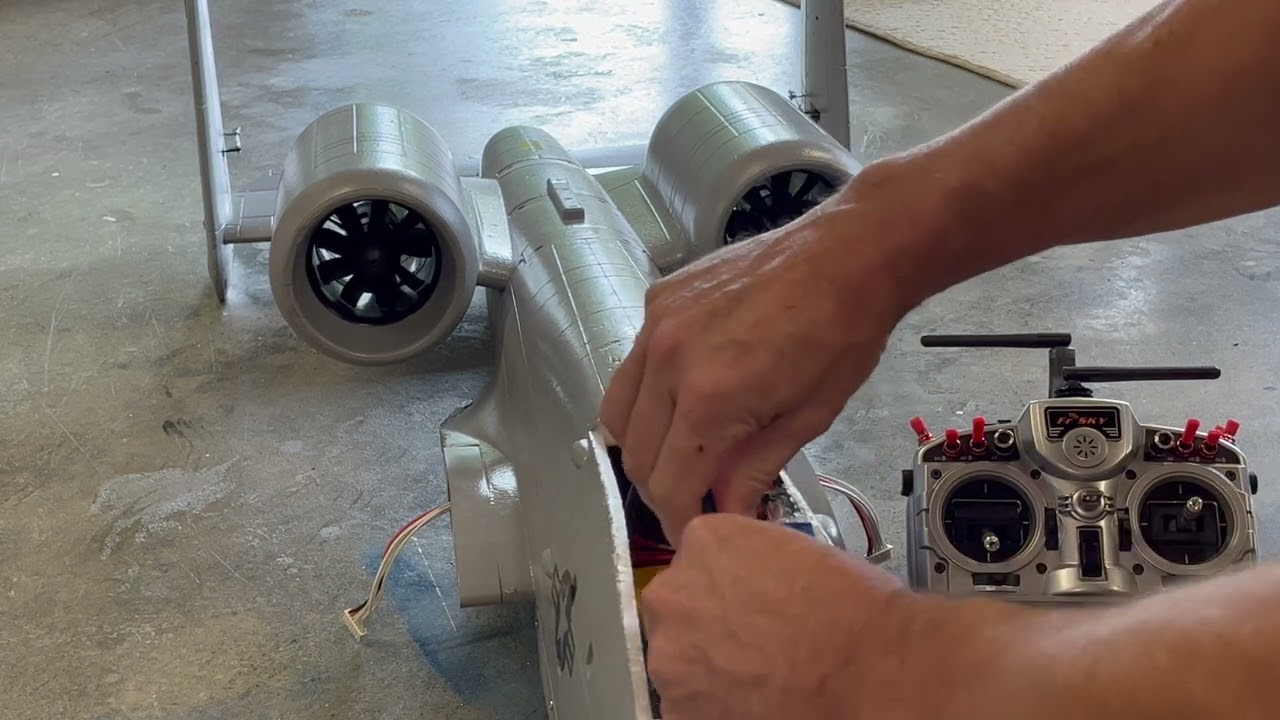
I made a video during one of my troubleshooting sessions. It's a bit inconsistent, sometimes it will stay at WOT just long enough for me to "trust" it, and then it cuts out. UGH! Give me a carburetor and a screwdriver Ha!
Leave a comment:
-
-
I used the trailing link nose gear for quite a while as it was recommended for grass over the stock nose gear. The problem I had, as well as a few others in this forum, was that occasionally when fully depressed it would rub against the open gear door and sometimes get stuck, causing the nose wheel to lock and not rotate. One hell'ava brake. Happened a couple times on landing and once on take off, but caused it to almost come to a screeching halt. That was enough, could have re-engineered it, but just put the stock back on.Leave a comment:
-
I am using this one, They claim it has a stiffer spring, but the geometry makes it feel better. Maybe not for purely vertical action, but if you run into something, the trailing link should help a lot if you hit holes, ruts, or the edge of the runway if you ran off and are taxiing back.
Leave a comment:
-
Wondering if people are replacing the nosewheel strut spring with a softer one ? The stock one seems very stiff and takes quite a bit of force to get any movement/compression.
Thanks. BobLeave a comment:






Leave a comment: